Shenzhen Institute Develops Robotic System for Neurointerventional Procedures
News related to:Shenzhen Institute of Advanced Biomedical Robot Co., Ltd · 3 min read
SHANGHAI, Oct. 22, 2026 /CourierPR/ -- Shenzhen Institute of Advanced Biomedical Robot Co., Ltd. has made significant strides in the field of neurointerventional robotics with the development of PANVIS STAR®, a new-generation vascular interventional surgical robot. This advancement marks a pivotal moment in the evolution of robotic assistance in neurointerventional procedures, moving beyond mere angiography to full therapeutic capabilities.
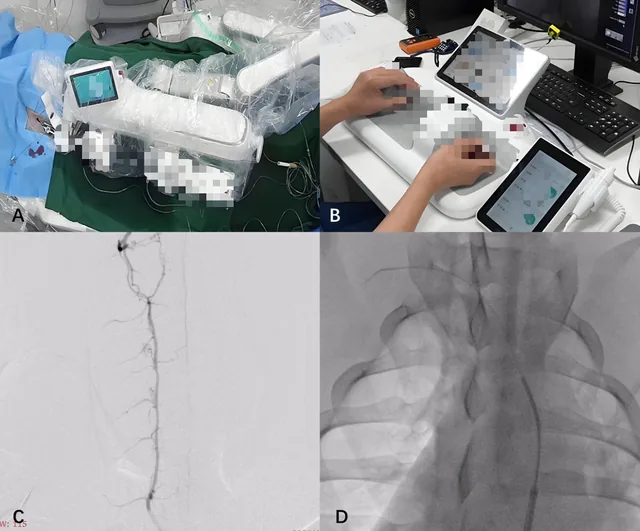
The company collaborated closely with Professor Jianmin Liu's team at Shanghai Changhai Hospital to develop this innovative system. PANVIS STAR® is the first to achieve simultaneous coaxial control of three catheters and one guidewire, enabling the deployment of rapid-exchange devices such as balloons and balloon-expandable stents. The system’s master-slave collaborative architecture allows for precise linear delivery and rotation control, ensuring submillimeter-level accuracy during superselective navigation and device deployment.
In a preclinical study, the team successfully validated the system’s capabilities in five major neurointerventional procedures: cerebral angiography and establishment of therapeutic access, aneurysm coil embolization, flow diverter (FD) deployment, vertebral artery stenting, and carotid artery stenting. All procedures were completed successfully, with no device-related complications or vascular injury. The study, published in the Journal of Robotic Surgery, demonstrated that the entire process, from guidewire and catheter superselective navigation to implant deployment, was performed by the robot, while manual operations were limited to catheter sheath insertion, device exchange, and loading in a radiation-free environment.
The mechanical innovation of PANVIS STAR® lies in its ability to support multi-device collaborative operation, combining coaxial and rapid-exchange techniques. The system’s master controller, the "Catheter On Finger" (PANVIS COF®) design, features a horizontal-axis joystick, achieving 1:1 motion mapping between manual manipulation and robotic control. This design ensures that device advancement corresponds to "left-hand push forward," retraction to "right-hand pull back," and rotation to "vertical twisting." The horizontal layout of the control levers mirrors the spatial layout of guidewires and catheters on the procedure table, making it intuitive for operators.
The study utilized a porcine model to establish animal models, creating lateral wall aneurysms on the common carotid arteries of three anesthetized pigs. The team performed a total of five surgically created aneurysms, including coiling alone, FD implantation, and coiling + FD. Additionally, the right vertebral artery and common carotid artery were utilized for vertebral artery balloon-expandable stent angioplasty and carotid artery stenting (CAS), respectively. The objective was to validate technical feasibility rather than to simulate pathological stenosis.
The results of the study were promising. All planned procedures were performed successfully, with no relevant technical complications or vascular damage. The mean procedural time for each procedure was recorded, indicating that the robotic assistance did not increase the complexity of the procedure. The study highlighted the system’s ability to perform nearly all steps robotically, from catheter navigation to device deployment.
While the preclinical study demonstrated the technical feasibility of PANVIS STAR® for multiple neurointerventional procedures, the company acknowledges the need for larger-scale clinical trials with a manual control group to further validate its efficacy and safety. The system’s multi-device collaborative capability also opens up robotic applications for emergency scenarios such as mechanical thrombectomy in acute ischemic stroke and emergency embolization for aneurysmal subarachnoid hemorrhage. The team has completed a validation study of long-distance remote robot-assisted emergency surgery.
In conclusion, the preclinical pilot study by Shenzhen Institute of Advanced Biomedical Robot Co., Ltd. and its collaborators at Shanghai Changhai Hospital has demonstrated that the PANVIS STAR® multi-device robotic system is technically feasible for cerebral angiography, guiding catheter navigation, aneurysm embolization, flow diverter deployment, vertebral artery stenting, and carotid artery stenting. As a small-sample preclinical study, larger-scale clinical studies with a manual control group are still needed to further validate its efficacy and safety.