Pervaziv AI Launches Cortex Host Protocol Unifying Six AI Providers
News related to:Pervaziv AI · 3 min read
Francisco, CA (PRUnderground) October 13th, 2026 Pervaziv AI, an enterprise artificial intelligence and cybersecurity company, has launched Cortex Host Protocol, a new architecture that unifies six AI providers, Cortex, Codex, Copilot, Claude, Gemini, and OpenCode, under a single enterprise experience.
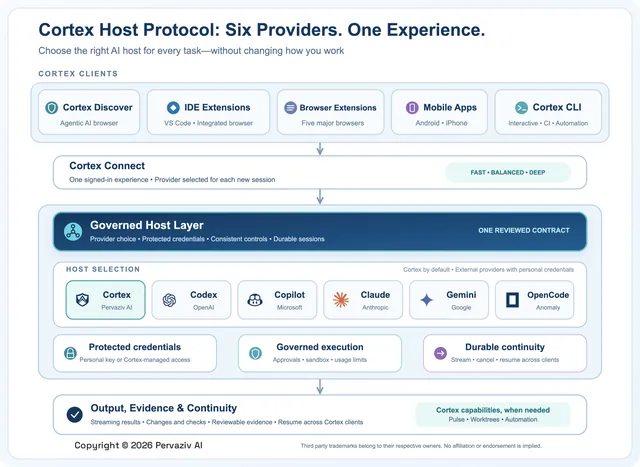
The new protocol introduces a common host layer that allows organizations to use multiple AI hosts through one consistent Cortex experience across various platforms, including browsers, development environments, mobile devices, and the command line. Users can select the host that best suits their needs without rebuilding their access methods, manage credentials, control execution, or continue their work seamlessly.
The launch of Cortex Host Protocol addresses the growing enterprise problem of operational fragmentation that arises when organizations work across several AI providers, each with different interfaces, accounts, permissions, billing relationships, and execution models.
Cortex Host Protocol is designed to separate provider choice from the operational fragmentation it can cause. It creates a common operating layer around the selected AI host, allowing users to begin with Cortex or choose Codex, Copilot, Claude, Gemini, or OpenCode for a new session. The provider may change, but the surrounding Cortex experience remains familiar.
Cortex Connect handles the relationship between the client and the selected host, ensuring that credentials stay protected, execution operates within defined boundaries, and the session retains its host identity. Results can continue into the broader Cortex platform when more advanced workflows, verification, automation, or security capabilities are needed.
The initial host choices include: - Cortex by Pervaziv AI, the native and default host, connecting users with Cortex intelligence, routing, security, validation, and broader enterprise capabilities. - Codex by OpenAI, providing an OpenAI-powered path for software development and coding agent workflows. - Copilot by Microsoft, allowing organizations with existing Microsoft development investments and entitlements to bring that host into the Cortex experience. - Claude by Anthropic, providing another option for coding, analysis, technical investigation, and complex work. - Gemini by Google, bringing a Google AI option for organizations and users with approved Gemini access. - OpenCode by Anomaly, adding an open source host option that can operate with configured upstream models and credentials.
Cortex does not attempt to make six different systems behave identically. Instead, Host Protocol establishes a consistent contract around how those systems enter enterprise work, creating a stable layer above the AI market. Multi-provider AI becomes difficult to manage when every application becomes another place to configure and store access credentials. Cortex Host Protocol separates the client experience from the provider secret, allowing organizations to support approved personal credentials or Cortex-managed access depending on policy and provider configuration.
The billing relationship remains clear as well. A personal credential continues to use the provider relationship associated with that account, while managed access follows the limits and policies established by the organization. If access expires or is revoked, Cortex does not silently substitute another payer or provider, making credential ownership part of the session contract.
AI governance becomes considerably harder when every provider defines its own operating boundary. Cortex Host Protocol places an additional control layer around the host session, allowing organizations to determine which providers are available, where they can operate, what workspace access is permitted, which actions require approval, and what usage limits apply. These boundaries can also reflect the client, with an IDE or Cortex CLI session supporting approved project activity when the environment provides the necessary controls, and browser and mobile experiences using more restrictive access when appropriate.
Cortex therefore binds a session to its selected host and credential context, ensuring that a user can choose another provider when beginning a new session, but an active session does not quietly migrate between providers. Reconnection preserves the relationship, and recovery retains ordered progress. A resumed session does not attach itself to another account simply because another credential is available.
The market can change underneath the experience, with a new model becoming the preferred option, an enterprise changing vendor strategy, a provider being restricted, or a new open source host emerging. The enterprise should not have to rebuild its operating model every time that happens. Cortex remains the native default while Codex, Copilot, Claude, Gemini, and OpenCode expand the choices available around it.
Users choose the intelligence appropriate for the task, and organizations retain a consistent layer for access, execution, continuity, and control. Six providers. One Cortex experience. The AI can change, but the way the enterprise works does not have to.