IQuest-Q1 Model Shows Promise in Coding and Interactive Application Generation
News related to:IQuest Research · 2 min read
BEIJING, Oct. 8, 2026 /CourierPR/ -- IQuest-Q1, a new model from IQuest Research, has garnered early praise from developers and industry watchers for its performance in coding, software engineering, interactive application generation, and long-horizon agentic workloads. The model, which is publicly available on GitHub and Hugging Face, is designed to handle tasks that developers face in their daily work, such as navigating repositories, driving terminals, calling tools, and completing multi-step tasks without losing context.
Developers can use IQuest-Q1 to generate interactive applications from natural-language prompts. For instance, the model can produce a fully functional first-person shooter (FPS) game in a single pass, generating the 3D scene, character movement, health, scoring, mode switching, and an in-game shop for resources and gear. Similarly, it can handle the complexities of a racing game, extending the continuous scene and managing interaction-heavy applications without special prompting.
The model also excels in debugging real-world code. For example, it can analyze training curves, pull logs and execution traces, and reason back to identify bugs in code. In one case, IQuest-Q1 helped locate a stray space in the training trajectory that was causing a real RL (reinforcement learning) run to go off the rails. After removing the space, the metrics returned to normal.
IQuest-Q1 is capable of running multi-step tasks in real-world environments. It can read, call tools, and correct itself as new information becomes available, working across various tools and platforms such as chat, cloud documents, spreadsheets, and comment threads. This capability allows it to produce analysis, drafts, and revisions that are ready for handoff.
The architecture of IQuest-Q1 is a decoder-only Transformer with a sparse Mixture-of-Experts feed-forward, totaling approximately 320 billion parameters, with about 15 billion active per token. The model undergoes training in three stages: pre-training, mid-training, and post-training. The post-training phase focuses on software engineering, long-horizon agentic tasks, and general reasoning, using supervised fine-tuning and reinforcement learning. Multi-Teacher On-Policy Distillation (MOPD) consolidates strengths from several teachers, ensuring the model picks up capabilities without inheriting any one teacher's bias profile.
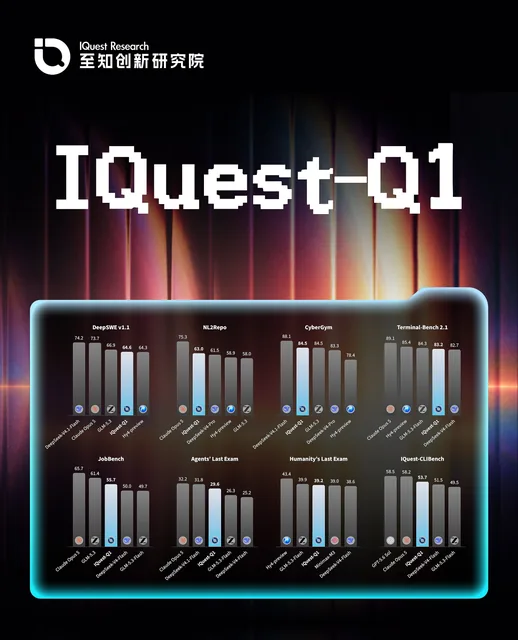
Evaluations across various benchmarks show balanced results. IQuest-Q1 performs well in tasks such as repository-level code generation (NL2Repo), cybersecurity (CyberGym), terminal operation (Terminal-Bench 2.1), long-horizon coding (DeepSWE v1.1), and professional office workflows (JobBench).