Global 300mm Fab Equipment Spending to Reach $227 Billion by 2029
News fromCourierPR · 2 min read
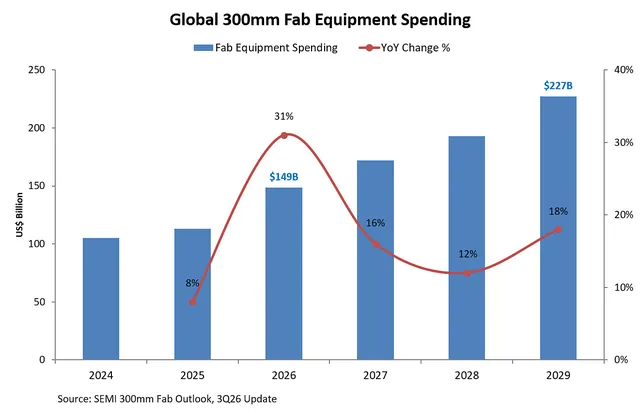
SAN FRANCISCO, Oct. 13, 2026 /CourierPR/ -- The semiconductor industry is set for a significant expansion, with global 300mm front-end fab equipment spending projected to reach $149 billion in 2026, up 31% year-over-year, according to SEMI, the global industry association. This growth is expected to continue at double-digit rates through 2029, with spending reaching $227 billion.
The strong investment trajectory is accompanied by a sustained pipeline of new 300mm fabrication (fab) facilities and production lines moving through construction and into operation. Excluding pure research and development (R&D) fabs, SEMI projects 20 new 300mm fabs or lines to begin construction worldwide in 2026 and 18 in 2027. In the United States, three are projected to begin construction in 2026 and four in 2027.
Global fab construction spending is projected to rise 23% to $47.5 billion in 2026 and another 33% to $63.3 billion in 2027, before reaching $68.4 billion in 2028. The construction activity reflects continued investment in new manufacturing capacity across leading-edge logic, memory, and other 300mm semiconductor technologies.
The U.S. represents an important part of this expansion, with additional 300mm fabs and lines expected to begin construction throughout the forecast period. Equipment investment in the Americas is projected to more than double from $18.1 billion in 2026 to $40.6 billion in 2029, reflecting the region's expanding manufacturing footprint. SEMI projects 13 new 300mm fabs or lines worldwide to begin operations or ship first silicon in 2026, increasing to 23 in 2027.
The 3Q26 edition of the SEMI 300mm Fab Outlook reflects 166 changes across 163 fabs and lines, including 14 newly added records, since the previous report. SEMI, an industry association connecting over 4,000 companies and 1.5 million professionals worldwide across the semiconductor and electronics design and manufacturing supply chain, is driving this expansion.
This growth in fab equipment spending and construction is expected to support the development of advanced semiconductor technologies, including those critical for artificial intelligence and high-performance computing. The expansion of manufacturing capacity in the U.S. is also anticipated to bolster the region's position in the global semiconductor market.