Consumer AI Spending Tripled While User Growth Stagnated
News related to:Menlo Ventures · 3 min read
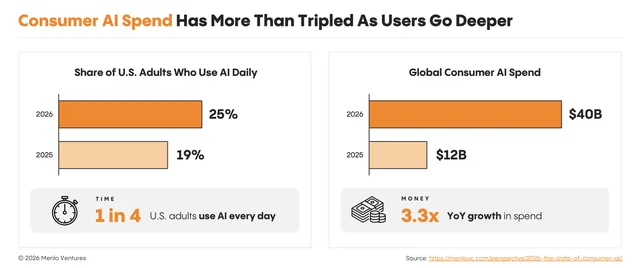
MENLO PARK, Calif., Sept. 16, 2026 /CourierPR/ -- Menlo Ventures, a leading venture capital firm, released its 2026 State of Consumer AI report, revealing that consumer spending on AI tripled to $40 billion this year, while user growth barely budged. According to the report, 64% of U.S. adults now use AI, up just three percentage points from 61% in the previous year. Globally, the AI user base grew by 11%, from 1.8 billion to 2 billion people.
The report highlights that the significant increase in spending came from existing users who are spending more time and money with AI. More than half (55%) of AI users now pay for at least one AI product, and 46% of those payers say they spend more than they did a year ago. Daily AI use rose from 19% to 25% of U.S. adults, and 52% of AI users say they use AI more than they did a year ago.
Amy Wu Martin, a partner at Menlo Ventures, commented, "The biggest surprise this year is that the consumer AI market more than tripled without a wave of new users. Growth came from power users bringing AI into more parts of their lives, spending more time and money with it, and increasingly letting it act on their behalf."
Competition among leading AI assistants intensified. ChatGPT remains the most-used assistant, reaching 60% of U.S. AI users, with Gemini close behind at 58%. Claude, an AI assistant from Menlo Ventures' portfolio company Anthropic, nearly tripled its reach, from 7% of AI users in 2025 to 20% in 2026. Consumers are also increasingly using multiple assistants rather than choosing one: the average U.S. AI user now uses three general AI assistants, up from 2.2 last year.
Nearly half (48%) of U.S. AI users have made money with AI, across various activities such as content creation, freelance work, businesses, side projects, and investing. AI has become the default for a growing set of everyday tasks, including writing, coding for work or school, completing assignments, creating images, building presentations, and making games. Health questions posted the largest year-over-year increase of any activity measured, rising 11 points to 25% of U.S. adults.
Consumers are starting to let AI act for them. 41% of U.S. AI users have tried an AI agent, and 24% use one regularly. Nearly one-third (32%) have allowed AI to take an action at least once without final approval. Regular agent users are among the market's deepest users: 92% pay for AI, compared with 55% of AI users overall.
Trust has overtaken convenience as the primary factor in choosing an AI product. When choosing an AI product, U.S. respondents now rank accuracy (45%), trustworthiness (40%), and security and privacy (36%) ahead of ease of use (32%). At the other end of the market, resistance is hardening: 70% of non-users distrust AI-generated information, up from 58% in 2025.
The share of consumers who still don't use AI fell only three points, to 36% of American adults this year. Within that group, every values-based objection hardened. The share who say AI tools are biased crossed a majority for the first time, from 40% to 52%; 83% now prefer human interaction; and 76% cite privacy concerns. Practical barriers, meanwhile, barely moved. The share who said they didn't know how to use AI was statistically unchanged, while lack of access declined.
Doe, the chief executive, said, "The most valuable AI customers aren't the people who dabble with it; they're the people who live in it. The companies that earn enough trust to act on someone's behalf will build the deepest customer relationships."
Menlo Ventures' 2026 State of Consumer AI report examines consumers' deepening engagement across four dimensions: time, money, tasks, and autonomy. The report explores how frequently consumers use AI, what they are willing to pay for, which areas of their lives they are bringing it into, and how much authority they are willing to delegate.