Seoul National University Develops AI System to Improve SSD Failure Prediction
News related to:Seoul National University of Science and Technology · 2 min read
SEOUL, South Korea, Researchers from Seoul National University of Science and Technology (SEOULTECH) have developed a new AI system that can more accurately predict SSD (solid-state drive) failures in large-scale data centers, potentially saving companies significant maintenance costs and preventing service disruptions.
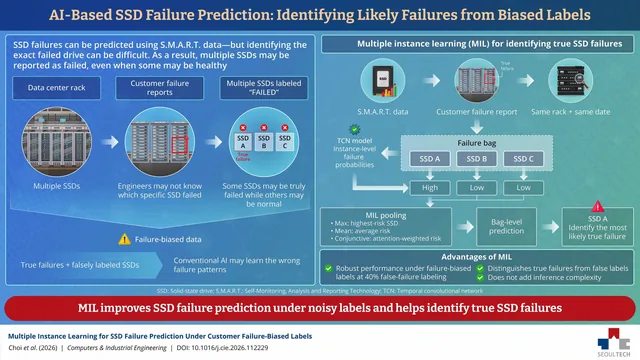
The study, led by Assistant Professor Jaewoong Shim from the Department of Data Science, addresses a common challenge in using machine learning to predict SSD failures. Conventional models often struggle with false failure reports, where multiple drives in the same rack are incorrectly labeled as failed. This can lead to healthy drives receiving failure labels, which can mislead maintenance teams and result in unnecessary replacements.
To overcome this issue, the research team employed a technique called Multiple Instance Learning (MIL). By grouping SSDs reported from the same rack on the same date, the model can learn from group-level information while still estimating the failure risk of individual drives. This approach was tested using real-world SSD data from an Alibaba Cloud data center and was published in Volume 219 of Computers & Industrial Engineering in September 2026.
The researchers evaluated the model's performance using an F1 score, which balances precision and recall. Under a 0% false-failure condition, a conventional model achieved an F1 score of 0.731. However, when the researchers simulated a 40% false-failure rate in the training data, the conventional model's score fell to 0.261. In contrast, the mean-pooling variant of the proposed approach achieved an F1 score of 0.717 under the same 40% condition, demonstrating greater resilience to inaccurate failure labels.
The model's ability to distinguish genuine failures from healthy SSDs incorrectly reported as failed is a significant improvement. On average, true failures were ranked 1.6, while incorrectly reported failures were ranked 3.5. This distinction can help data-center operators prioritize inspections, backups, monitoring, and SSD replacements, enabling them to focus resources on drives most likely to require attention.
Shim.
The research team's approach is not limited to SSDs. Dr. Shim noted that it could also be useful for other industrial settings such as battery packs, industrial machinery, and other systems where a problem can be identified within a group, but the exact component responsible is difficult to determine.
This new AI system represents a significant step forward in the reliability and efficiency of data center operations, particularly in environments where SSD failures can have significant financial and operational impacts.