Center for Responsible Food Business Calls on Lawmakers to Return Contributions from Chinese-Owned Agribusiness
News related to:Center for Responsible Food Business · 2 min read
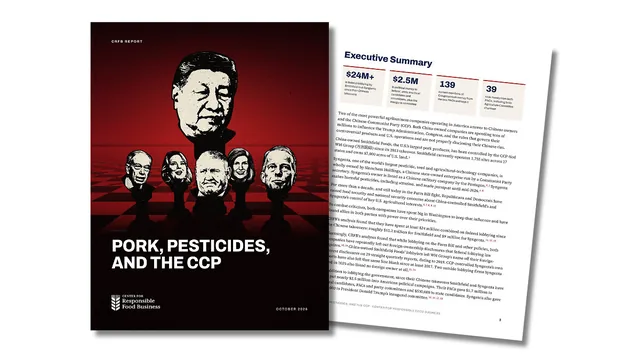
WASHINGTON, Oct. 22, 2026 /CourierPR/ -- The Center for Responsible Food Business (CRFB) has called on 139 sitting federal lawmakers to return campaign contributions from Chinese-owned agribusiness giants Smithfield Foods and Syngenta. The organization’s latest report, titled “Pork, Pesticides, and the CCP,” details the extensive lobbying and political spending by these companies since their Chinese acquisitions.
According to the CRFB, Smithfield Foods and Syngenta have spent over $24 million on lobbying efforts since their Chinese takeovers. This spending has been directed at influencing the Farm Bill, pesticide regulation, and the foreign ownership of U.S. farmland. The report highlights that on 29 consecutive quarterly reports since 2019, Smithfield’s lobbyists have answered "None" or left the line blank regarding any foreign entity with an interest in the issues lobbied. Similarly, Syngenta’s own reports have left the same line blank since at least 2017. Two outside firms hired by Syngenta in 2025 also listed no foreign owner at all.
The CRFB’s findings also reveal that the companies have spent nearly $2.5 million on political contributions. Specifically, China-owned Smithfield and Syngenta’s Political Action Committees (PACs) gave $1.7 million to federal candidates and committees and $530,000 to state candidates. Syngenta also contributed $250,000 to President Trump’s inaugural committee.
The report points out that at least 39 lawmakers received contributions from these companies’ PACs. Among them are House Agriculture Chairman Glenn “GT” Thompson (R-PA) and Senate Agriculture Chairman John Boozman (R-AR). The CRFB argues that these lawmakers should return the money or donate it to charity to show their constituents that they prioritize American interests.
The CRFB further states that Syngenta’s aggressive lobbying and political contributions have influenced policy outcomes. After Syngenta’s $250,000 inaugural gift and lobbying efforts, the final MAHA strategy dropped Syngenta’s weed killer atrazine by name. Additionally, the Environmental Protection Agency (EPA) approved two new Syngenta pesticides that critics classify as “forever chemicals.”
Smithfield’s Farm Bill priorities have also been advanced through contributions from its PAC and their pork industry lobby group. Lawmakers like House Agriculture Chairman GT Thompson (R-PA) and Sen. Joni Ernst (R-IA) who received contributions from Smithfield’s PAC have led efforts to push the Save Our Bacon Act. This bill would overturn state farm animal welfare laws.
The CRFB notes that in July 2025, Agriculture Secretary Brooke Rollins vowed to “claw back” U.S. farmland held by Smithfield and Syngenta. However, the organization found no federal action since then.
The CRFB is calling on all 139 currently serving lawmakers who received the companies’ PAC contributions after the Chinese acquisitions to return the money or donate it to charity. Two Republicans, Reps. Dan Newhouse (R-WA) and Derrick Van Orden (R-WI), have already done so.
The organization is also calling on the Secretary of the Senate and the Clerk of the House to refer the companies’ lobbyists and their noncompliant filings to the U.S. Justice Department.