Black Forest Labs Releases FLUX 3 Image Klein for Customizable AI
News related to:Black Forest Labs · 3 min read
FREIBURG, Germany, Oct. 15, 2026 /CourierPR/ -- Black Forest Labs, a global frontier AI research lab, has expanded access to its advanced visual intelligence technology with the open weights release of FLUX 3 Image Klein. This latest model, described as the company's most capable open weights image model to date, is designed to provide developers and businesses with greater freedom to build, customize, and deploy visual AI.
FLUX 3 Image Klein is a significant advancement in the field, offering the quality of a large frontier model with the customization and speed of open weights. It runs on consumer GPUs and laptops, making it accessible to a broader audience. The model retains features from the larger FLUX 3 Image model, including native 4K generation, bounding boxes, and pixel-perfect editing. It includes a base model for fine-tuning, a distilled model for low-latency generation, and quantized FP8, NVFP4, and INT8 versions, catering to different needs and performance requirements.
The release follows September's open weights release of FLUX 3 Action, which focused on robotics. Today's release brings the company's latest research to core creative use cases, enabling developers and businesses to leverage the same foundation for various applications. Black Forest Labs has consistently released its research findings alongside open weight versions of its industry-leading FLUX models, allowing others to build on its advances. So far in 2026, the team has published its Self-Flow research, released open weights for the FLUX.2 [Klein] family in January, and FLUX 3 Action in September. Self-Flow improved generation across images, video, and audio, while helping models learn representations that can support robot control. This research led to BFL’s most capable model to date, FLUX 3, which brings multimodal generation and action prediction into a shared architecture.
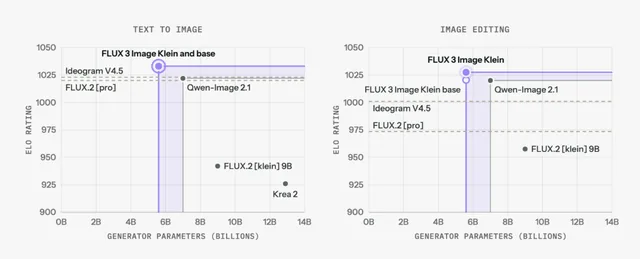
FLUX 3 Image Klein scores higher than current leading open weights image models in text-to-image, multi-reference generation, and image editing, while costing less through the company’s API. With 5.6 billion parameters, it runs on consumer GPUs and laptops with as little as 8 GB of VRAM. The model draws on FLUX 3’s shared learning across images, video, and audio, with images contributing spatial detail, video adding motion and physical dynamics, and audio providing information about events and interactions. Together, these signals help the model learn how the visual world behaves.
The open weights release of FLUX 3 Image Klein builds on BFL’s roots in image generation. Founded by the researchers who pioneered latent diffusion, Stable Diffusion, and the FLUX model family, the company has been developing frontier, production-ready image models since 2024. These models power creative tools across platforms including Adobe, Canva, Meta, and Microsoft. Open weights image models built by BFL’s founding team, from the original Stable Diffusion to FLUX and their community derivatives, remain among the most widely adopted, with more than 640 million downloads on Hugging Face.
FLUX 3 Image Klein supports text-to-image generation, image editing, and generation using multiple reference images. BFL is releasing both a base model for fine-tuning and research, and a step-distilled version that generates images in fewer sampling steps. The distilled version is also available through BFL’s API, where it runs with BFL’s prompt enhancement and pixel-level editing pipeline for production workloads. Support for Ostris’s AI Toolkit at launch will help developers fine-tune the model using their own examples. The release will also be supported by developer tools and platforms including ComfyUI, Diffusers from Hugging Face, vLLM-Omni, and SGLang Diffusion, making it easier to customize and deploy.
FLUX 3 Image Klein was trained on NVIDIA GB200 GPUs NVL72 and optimized for NVIDIA’s accelerated computing platform. Developers can fine-tune it with NVIDIA NeMo AutoModel and run it locally on NVIDIA GeForce RTX GPUs with 8 GB or more of VRAM. The model is available under the FLUX Kommunity License, which allows free commercial use for individuals and companies with annual revenue under $5M. Larger organizations can deploy commercially through BFL’s self-hosted licensing options or API. This flexibility is particularly valuable for enterprises seeking greater control over model behavior, data handling, and deployment.
Black Forest Labs, valued at $3.25 billion, has raised more than $450 million from leading venture and strategic investors including a16z, AMP, Salesforce Ventures, NVIDIA, General Catalyst, Adobe Ventures, Figma Ventures, and Canva. The company has its headquarters in Freiburg, Germany, and San Francisco, USA.