

 Read article 'Neural networks boost B-tagging'
Neural networks boost B-tagging
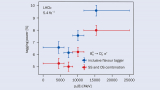
The LHCb collaboration developed an inclusive deep-learning flavour tagger for neutral B-mesons, improving tagging power by up to 35%.

 Read article 'Neural networks boost B-tagging'
The LHCb collaboration developed an inclusive deep-learning flavour tagger for neutral B-mesons, improving tagging power by up to 35%.
 Read article 'Machine learning and the search for the unknown'
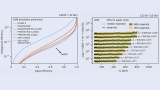
The CMS collaboration is employing neural networks to conduct model-independent searches for short-lived particles that could escape conventional analyses.
 Read article 'Hidden treasures'
As the LHC surpasses one exabyte of stored data, Cristinel Diaconu and Ulrich Schwickerath call for new collaborations to join a global effort in data preservation.
 Read article 'Quantum simulators in high-energy physics'
Enrique Rico Ortega and Sofia Vallecorsa explain how quantum computing will allow physicists to model complex dynamics, from black-hole evaporation to neutron-star interiors.
 Read article 'New frontiers in science in the era of AI'
New Frontiers in Science in the Era of AI arrives with a clear mission: to contextualise AI within the long arc of scientific thought and current research frontiers.
 Read article 'Accelerators on autopilot'
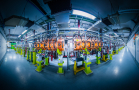
Verena Kain highlights four ways machine learning is making the LHC more efficient.
 Read article 'Machine learning in industry'
Antoni Shtipliyski offers advice on how early-career researchers can transition into machine-learning roles in industry.
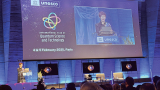 Read article 'An international year like no other'
The International Year of Quantum inaugural event was organised at UNESCO Headquarters in Paris in February 2025.
 Read article 'Game on for physicists'
Raphael Granier de Cassagnac discusses opportunities for particle physicists in the gaming industry.
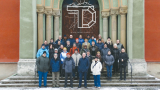 Read article 'The triggering of tomorrow'
The third TDHEP workshop explored how triggers can cope with high data rates.