Toward Health Study Shows Significant Reduction in Cardiovascular Risk
News related to:TOWARD Health · 2 min read
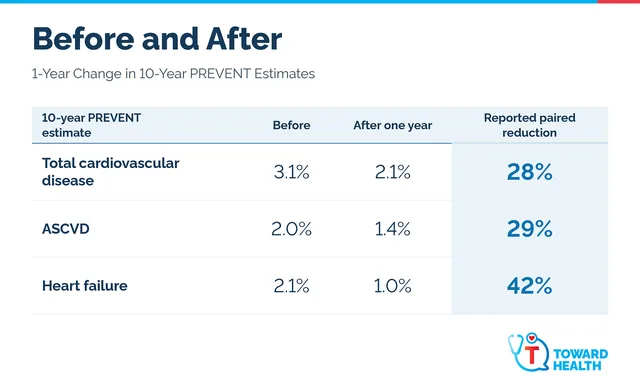
BLAUVELT, N.Y., Oct. 5, 2026 /CourierPR/ -- TOWARD Health, a physician-led metabolic health practice, has announced significant improvements in cardiovascular risk factors among participants in a 120-patient study. The one-year intervention, which combines health coaching, remote monitoring, and a low-carbohydrate, real-food ketogenic diet, resulted in a 29% reduction in the estimated 10-year ASCVD risk and a 28% reduction in total cardiovascular disease risk.
The study, which used the American Heart Association's (AHA) PREVENT framework to assess cardiovascular, metabolic, and kidney health, demonstrated substantial benefits for participants. After one year, the cohort achieved a 12.2% median weight loss, a 10.7 mmHg reduction in systolic blood pressure, a 0.48 percentage-point reduction in HbA1c, and a 34 mg/dL reduction in triglycerides. Notably, 89 out of 90 participants experienced weight loss, and 125 medications were discontinued.
Dr. Laura Buchanan, Executive Director of Physicians at Toward Health, explained that the intervention was designed to challenge conventional dietary recommendations. "And the results were surprising."
The study's findings are particularly noteworthy because they align closely with those of bariatric surgery, which also showed a 29% relative reduction in 10-year ASCVD risk. However, the magnitude of the change in the TOWARD Health cohort is significant, as other commonly used dietary and medical interventions have shown smaller reductions in risk.
The AHA's current dietary recommendations, which emphasize whole grains, legumes, fruits, and the replacement of animal fats with seed oils, were not followed in the TOWARD Health intervention. Despite this, the study's outcomes suggest that real-food ketogenic approaches may provide an equally, or potentially more, effective path to improving metabolic and cardiovascular health.
TOWARD Health is now calling for a head-to-head trial to compare its approach with a conventional AHA and old dietary guidelines-aligned approach. The proposed research would evaluate changes in weight, glycemic control, diabetes remission, blood pressure, lipids, medication burden, quality of life, healthcare costs, cardiovascular risk, and longer-term clinical outcomes.
The current study, while retrospective and without a randomized control group, provides strong enough data to justify a direct comparison between the two competing dietary models. TOWARD Health believes that if saturated-fat caps and routine grain inclusion produce better outcomes, a rigorous randomized trial should demonstrate it. If they do not, the recommendations should change.
In summary, TOWARD Health's study challenges conventional dietary guidelines and suggests that real-food ketogenic approaches may offer an effective alternative for improving metabolic and cardiovascular health. The company is now advocating for a randomized clinical trial to further evaluate the effectiveness of its intervention.