Public sector tech leaders struggle to turn digital sovereignty priorities into action
News related to:Info-Tech Research Group · 3 min read
Public sector technology leaders are facing significant challenges in translating digital sovereignty priorities into actionable plans, according to a recent analysis by Info-Tech Research Group. The group's research highlights that while public sector organizations often identify clear areas of exposure, they struggle to convert these findings into concrete, executable steps within a fiscal quarter.
According to Info-Tech Research Group, the gap between digital sovereignty assessments and actual execution is a major hurdle. Public sector leaders frequently emerge from assessments with a thorough understanding of their vulnerabilities but lack the mechanisms to prioritize and implement these findings. This results in cross-functional silos, unclear ownership, and an expanding scope that can erode momentum before any operational results are achieved.
To address this issue, Info-Tech has developed a comprehensive blueprint titled "Build Your Digital Sovereignty Execution Plan." This resource provides a four-phase approach to help leaders turn high-level priorities into a 90-day action plan. The blueprint guides organizations through a structured process that narrows the work to five to eight executable recommendations and assigns accountable owners. It also helps leaders sequence the work, map dependencies and risks, and prepare the necessary governance and communication artifacts for executive authorization.
Andy Best, research director at Info-Tech Research Group, explains, "Public sector leaders often know their sovereignty priorities, but progress stalls when no one owns the next decision and the work expands beyond what can realistically move in a fiscal quarter." He adds, "A 90-day sprint creates the discipline to break silos, manage scope, establish accountability, and give executives visible evidence of progress before momentum is lost."
Info-Tech's analysis identifies several recurring obstacles that can prevent sovereignty priorities from advancing into operational delivery. These include: - Assessment-to-execution gap: Priorities are identified but there is no method to turn them into a bounded 90-day plan. - Cross-functional silos: Independent functions operate without a shared execution model. - Decision ambiguity: Missing owners, escalation paths, and formal gates leave critical decisions unresolved. - Scope inflation: A focused sprint expands into a long-term transformation as stakeholders add new demands. - Budget cycle misalignment: Initiatives miss reporting windows and lose funding momentum before progress becomes visible. - Procurement complexity: Jurisdictional requirements and local procurement preferences introduce additional criteria that can delay action.
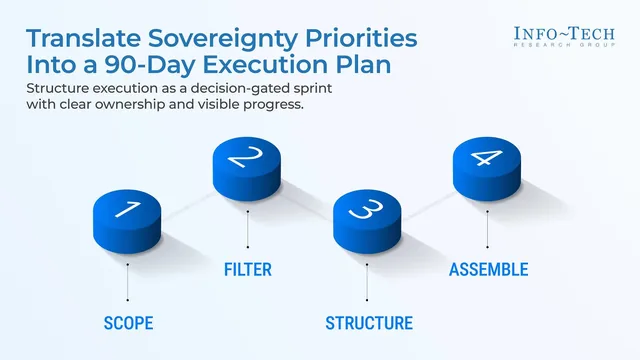
Info-Tech's four-phase approach addresses these challenges by: 1. Phase 1: Scope—Confirming the highest-priority sovereignty pressure zones, selecting five to eight operational recommendations, applying rapid triage, and documenting why the work belongs in the sprint. 2. Phase 2: Filter—Testing each recommendation for 90-day feasibility, classifying it by tier, naming an accountable owner, and documenting any conditions or mitigations. 3. Phase 3: Structure—Breaking each recommendation into execution elements, validating sprint readiness, documenting dependencies with evidence, and building a risk register with owners and mitigations. 4. Phase 4: Assemble—Assigning work items to phases and weeks, drafting the Digital Sovereignty Working Group Charter, preparing executive communications, and stress-testing the complete plan for readiness.
By completing the Build Your Digital Sovereignty Execution Plan blueprint, public sector organizations can produce a 90-day workplan, a signed working group charter, an executive communications package, a dependency validation report, and a risk register. Two supporting tools, the Build Your 90-Day Digital Sovereignty Workplan and Digital Sovereignty Working Group Charter, help internal teams launch the sprint and reuse the execution model for subsequent phases.
Info-Tech's approach establishes formal decision points throughout the sprint, ensuring that leaders commit to scope and confirm feasibility by Day 30, assign accountability and define execution by Day 60, and secure executive authorization by Day 90. The blueprint was developed as a companion to Info-Tech's Strengthen Your Organization's Digital Sovereignty, translating the assessment and strategic priorities established through that earlier research into a viable 90-day execution plan.