International Team Begins Core Drilling at Noah's Ark Site
News related to:Noah’s Ark Scans · 2 min read
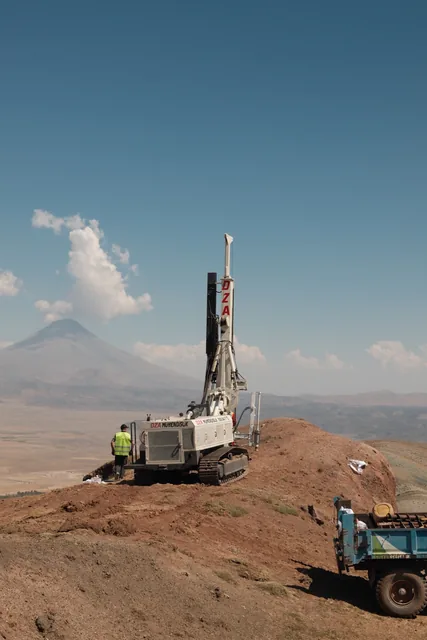
An international team of researchers and archaeologists has begun a groundbreaking core drilling operation at the Durupınar formation, near Mount Ararat in eastern Türkiye. This expedition, led by Turkish Professor of Archaeology Prof. Dr. Cenker Atila of Sivas Cumhuriyet University and supported by Noah’s Ark Scans, aims to uncover the mysteries surrounding the 157-meter (515-foot) boat-shaped feature first identified in 1959 by Turkish Army Capt. İlhan Durupınar.
The 2026 field program, which is the largest international permitted scientific expedition in the site’s recorded history, is part of a broader investigation into the Durupınar formation. The formation, long debated as either a natural landform or the buried remains of a large wooden vessel, has seen limited scientific scrutiny until now. Previous drilling attempts in 1988 were limited in depth and ultimately compromised by water contamination.
This year, the team is collecting continuous cores for laboratory analysis, including compositional, organic, and stratigraphic testing. The expedition also plans to insert the custom-built GOPHER underground exploration drone into mapped voids, tunnels, and corridors inside the formation. Named after the "gopher wood" of Genesis, GOPHER is equipped with a high-resolution camera designed to enter narrow borehole access points without opening large excavation trenches.
The drilling campaign, which has reached depths of up to 18 meters (nearly 60 feet), has already yielded significant findings. According to Andrew Jones, Vice President of the Noah’s Ark Research Project, the team has encountered layers of rich organic material that they believe could be the decayed top tier remains of the Ark. One of the most intriguing discoveries was a layer so hard that it broke the drill bit, suggesting the possibility of petrified or highly mineralized wood.
The expedition has also placed core holes both within the boat-shaped outline and in control locations beyond it to compare laboratory results against the surrounding mountainside. The team has reported multiple cavities, including one that continued to fill with water as the team drilled, indicating the presence of a “room” within the formation.
Prof. Dr. Atila, President of the research project and a faculty member in the Department of Archaeology at Sivas Cumhuriyet University, emphasized the importance of the findings.
The Genesis 6:14 (ESV) verse, which instructs Noah to make an ark of gopher wood, adds a biblical context to the ongoing investigation.
Noah’s Ark Scans, an international research initiative, has launched a fundraiser in partnership with GiveSendGo to support the 2026 expedition, lab testing, and further study in 2027. The organization aims to continue publishing updates as laboratory results come in over the next few months, marking a significant shift from remote sensing to physical evidence.
The findings from this expedition will be crucial in determining the true nature of the Durupınar formation and its potential connection to the biblical story of Noah’s Ark.