Intento Publishes Interactive Report on AI Translation Solutions
News related to:Intento · 2 min read
SAN FRANCISCO, Oct. 16, 2026 /CourierPR/ -- The report, accessible at inten.to/state-of-translation-automation, aims to help language engineers and businesses choose the most suitable AI translation solutions based on specific requirements such as translation quality, cost, and time.
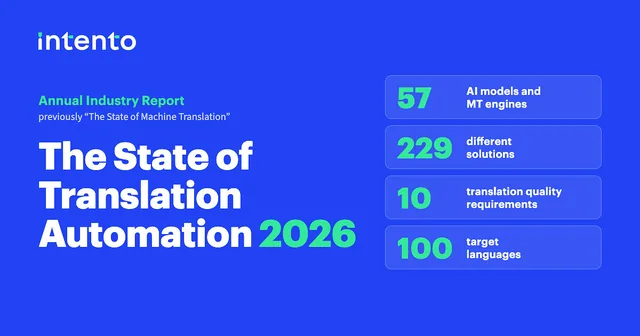
The evaluation process involved translating four English business texts totaling 2,978 words into 100 languages. Language engineers at Intento used two automated quality-estimation metrics to shortlist 10 to 13 solutions per language. The shortlisted translations were then assessed against 10 requirements across three levels of translation quality: Basic, Standard, and Advanced. Three LLM judges from different vendors identified errors by type and severity, with a fourth LLM combining their anonymized findings. The team accepted a result only where the three judges agreed on at least 90% of sentences.
The report highlights that more demanding translation quality requirements leave fewer languages with a one-step solution plus a qualifying backup. For Basic translation quality, 54 of the 100 languages have this combination. That number falls to 38 languages for Standard quality and 12 for Advanced quality. The backup may require additional steps. In 18 languages, automated checks are not reliable enough to assess every requirement.
Additional steps help LLM solutions meet the general translation quality requirement. Among the evaluated LLM solutions that initially fall short, 24% meet it after translation and post-editing, and 60% after translation, quality assessment, and repair. Real-time translation comes with a quality trade-off. None of the real-time one-step solutions assessed in 84 languages meets every Standard requirement. Across the 38 languages where a one-step solution does meet those requirements, the fastest qualifying solution takes a median of about 65 seconds per 1,000 source words.
The 57 models come from 37 vendors, including Alibaba, Amazon, Anthropic, Cohere, DeepL, DeepSeek, Google, Microsoft, Mistral, OpenAI, Tencent, and xAI. These models include neural machine translation models, MT systems based on large language models (LLMs), and commercial and open-weight LLMs. The report also tested two-step solutions that translate and then post-edit with an LLM, three-step solutions that translate, assess quality, and repair errors, and multi-agent systems for advanced translation requirements.
The Intento Enterprise Language Hub, a multilingual AI harness built on patent-based AI routing technology, covers every touchpoint, websites, apps, help centers, support, and internal tools, in 650 languages. The agents, built from 50+ specialized LLMs, produce, validate, and repair translations against the requirements of each company: terminology, tone of voice, formatting, compliance. Intento's language engineers implement everything end-to-end, identifying requirements, configuring translation and quality workflows, integrating with existing systems, so no in-house AI expertise is needed. The result is a scalable, automated translation program trusted by 60+ global enterprises, including Indeed, Hexagon, Strava, and Agilent.