Emdoor Information Boosts Custom Rugged Computing Solutions
News related to:Emdoor Information · 3 min read
SHENZHEN, China, Sept. 04, 2026 /CourierPR/ -- As digital transformation continues to reshape industries, there is a growing demand for custom rugged computing devices tailored to specialized environments. Emdoor Information, a leading provider of rugged computing solutions, has bolstered its end-to-end customization services to meet these unique requirements.
With a dedicated customization workshop and integrated hardware-and-software capabilities, Emdoor Information now offers comprehensive services including hardware and software modification, system integration, testing, and mass production. The company can currently produce over 400 customized devices daily, with standard configurations available for delivery in just 7 days.
Emdoor Information’s dedicated customization workshop is designed to streamline the modification process, ensuring rapid delivery of purpose-built solutions. The facility is divided into five functional areas: order preparation, hardware modification, testing and system flashing, quality inspection, and finished-product shipment. Each order is clearly identified and processed through a standardized workflow, with engineers handling component preparation, device disassembly, assembly, and verification in the hardware modification area. Customized operating systems and software configurations are batch-installed during the testing and flashing stage.
Quality control is integrated throughout the process. For orders of 10 units or more, 3 devices are randomly selected from every 10 units for comprehensive testing of displays, buttons, interfaces, and other key functions. Smaller orders undergo full inspection. After passing inspection, devices are cleaned, packaged, labeled with customized parameters, and prepared for shipment.
Emdoor Information’s customization capabilities extend across the entire hardware architecture of rugged computing devices. Customers can select from Intel, MediaTek, Qualcomm, and Rockchip platforms based on their performance, application, and technology requirements. This flexibility enables solutions to be optimized for applications ranging from industrial automation and equipment maintenance to field inspection and public-sector operations.
For projects requiring specialized hardware, Emdoor Information can customize motherboards, daughterboards, and adapter boards based on specific application requirements. Interface configurations can include Ethernet, serial ports, USB, CAN, PCIe, and other industrial interfaces, while specialized aviation-grade connectors can be integrated for demanding environments involving vibration and humidity. Additional modules such as 4G/5G, GPS, NFC, RFID readers, fingerprint recognition, RTK, 1D/2D barcode scanners, cameras, batteries, and expandable storage can also be integrated. Customers can further customize display brightness, resolution, touch technology, product labels, silk-screen printing, and laser engraving.
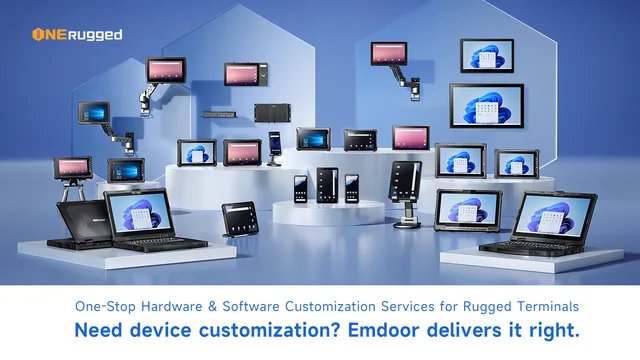
Whether the requirement involves a rugged tablet for mobile field operations, a rugged laptop for industrial maintenance, or a handheld terminal for scanning and data collection, Emdoor Information can provide hardware configurations tailored to specific workflows.
Software customization is also a key part of Emdoor Information’s offerings. The company supports Windows, Android, and Linux operating systems, allowing customers to customize startup logos and animations, pre-install business applications, configure automatic application launch, create application whitelists, disable unnecessary hardware modules, and remove redundant system services and pre-installed applications. For Android devices, Emdoor Information provides proprietary software tools supporting functions including button customization, barcode configuration, local device management, and remote updates. Its MDM platform can centrally manage up to 500 terminals simultaneously.
Windows devices feature an integrated Control Center for device information, battery management, button customization, network switching, and system backup and restoration. Security functions can also be configured, including hardware module restrictions, default IP settings, device permission controls, lock-screen notification management, and role-based access for administrators and standard users.
For customers requiring more extensive product development, Emdoor Information offers end-to-end customization from concept to mass production through an Integrated Product Development (IPD) management model. Cross-functional teams spanning product planning, R&D, manufacturing, and testing work together throughout the project, while a PLM system supports standardized processes and information sharing. Complex projects proceed through five key stages: Product Initiation, Engineering Validation Test (EVT), Design Validation Test (DVT), Production Validation Test (PVT), and Mass Production (MP). Each stage includes defined validation requirements, providing customers with greater visibility and control over project progress.
With nearly two decades of experience in rugged computing and customized terminal solutions, Emdoor Information has served more than 1,600 partners and customers across over 100 countries and regions. The A-share listed company has more than 1,500 employees, with R&D personnel accounting for approximately 40% of its workforce. Its manufacturing capabilities include a 20,000-square-meter smart factory, million-level annual production capacity, and more than 200 sets of testing and laboratory equipment. By integrating R&D, manufacturing, testing, customization, and service capabilities, Emdoor Information can support customized rugged tablet, rugged laptop, and handheld terminal projects while maintaining consistent quality throughout the process.
Emdoor Information is building a comprehensive customization ecosystem for rugged computing, turning specific operational requirements into reliable, production-ready devices. The company aims to help businesses deploy rugged technology that fits their workflows, rather than forcing workflows to fit standard hardware.