Descartes Reports Increased Investment in Transportation Technology
News related to:Descartes Systems Group · 2 min read
Descartes Systems Group, the global leader in uniting logistics-intensive businesses in commerce, has released the findings of its 10th Annual Global Transportation Management Benchmark Survey. The study reveals a significant shift in how transportation is viewed by organizations, moving from an operational function to a strategic driver of business growth, customer experience, and competitive differentiation.
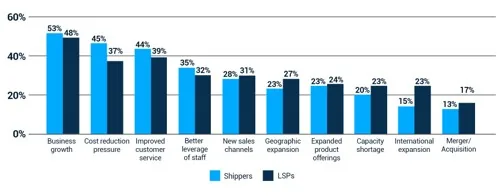
Over the past decade, the percentage of North American organizations planning to increase transportation management (TM) technology investment has surged from 53% in 2017 to 78% in 2026. This trend underscores the growing importance of transportation technology in driving business outcomes. According to the survey, 85% of organizations now view transportation as either a competitive weapon or a customer service differentiator, up from 65% in 2017. Business growth remains the leading driver of transportation management system (TMS) adoption for both shippers (53%) and logistics service providers (LSPs) (48%).
However, despite this increased strategic importance, the study highlights significant opportunities for operational maturity. Only 19% of shippers and 15% of LSPs report using AI at scale, with most organizations still exploring, piloting, or partially deploying it. Data quality is cited as the leading barrier to scaling AI, with 45% of LSPs and 33% of shippers citing it as a challenge. Integration complexity follows closely, with 38% of shippers and 39% of LSPs reporting it as an issue.
Alan Dunkerley, SVP of Product Management at Descartes, commented, "Ten years of benchmark research show that the transportation technology conversation has fundamentally changed. Organizations are increasingly focused on how to maximize the value of transportation technology. With AI now a strategic priority, the ability to connect transportation networks, automate processes, and create high-quality, real-time data will be critical to moving AI from experimentation into scaled transportation operations."
The survey also found that growth expectations remain resilient, with 79% of shippers expecting at least 5% annual growth over the next two years, and 84% of LSPs expecting the same. Cost pressures remain significant, with freight cost management being the largest current transportation challenge for shippers (35%) and LSPs (25%). Rising industry costs are also expected to impact transportation management over the next five years.
Shippers report the greatest realized AI benefit in reduced administrative and labor costs (55%), while LSPs cite improved service (53%) and freight cost reduction (46%). Full truckload is the mode most frequently identified as needing better real-time visibility, with 57% of shippers and 43% of LSPs citing it as a need, up from 43% and 24% in 2025, respectively.
Increasing AI adoption is the top transportation priority for shippers and LSPs combined (58%) over the next two years, with reducing freight costs a close second (57%). The findings suggest that organizations must focus on building the digital infrastructure necessary to scale AI effectively across transportation networks.
Descartes Systems Group surveyed 600 senior transportation decision-makers globally, including 300 across the United States and Canada, evenly split between shippers and LSPs. The respondents represented manufacturers, distributors, and retailers, as well as freight brokers, freight forwarders, and third- and fourth-party logistics providers. The goal was to benchmark the transportation management sector, understand transportation strategies, operations, and visibility, identify key industry challenges, and explore AI adoption, benefits, and barriers to scale.