U.S. Workers Struggle with Retirement Savings Due to High Costs and Uncertainty
News related to:Transamerica Institute · 4 min read
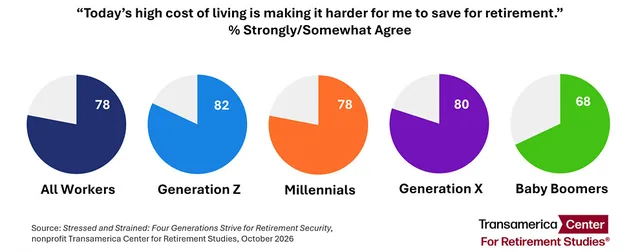
LOS ANGELES, Oct. 28, 2026 /CourierPR/ -- In a new report, the nonprofit Transamerica Center for Retirement Studies (TCRS) and Transamerica Institute have examined the retirement outlook for four generations of American workers, revealing that the current high cost of living is making it increasingly difficult for them to save for retirement.
The report highlights that the U.S. retirement system now places a greater responsibility on workers to fund their own retirement compared to previous generations. This shift is exacerbated by persistent inflation, competing priorities, and potential employment disruptions, creating a "perfect storm" for workers' retirement security.
Among the findings, 65% of workers agree that they could work until retirement and still not save enough to meet their needs. Additionally, 73% of workers are concerned that Social Security will not be there for them when they are ready to retire. Moreover, 41% of workers cite outliving their savings and investments as one of their greatest retirement fears.
The report provides an in-depth examination of the retirement preparedness of workers across generations, including Generation Z, Millennials, Generation X, and Baby Boomers. It offers insights into their health and well-being, employment, personal finances, and retirement outlook.
For Generation Z, born between 1997 and 2012, the report states that 50% of workers aged 18 and older are struggling to make ends meet. Among this group, 28% have more than one job, and 52% have a side hustle. The current financial priorities for Generation Z workers include paying off debt (56%), building emergency savings (47%), saving for a major purchase or life event (47%), saving for retirement (40%), and just getting by to cover basic living expenses (40%). Additionally, 25% of Generation Z workers cite supporting their parents as a financial priority.
One in three Generation Z workers (34%) are either currently serving or have served as caregivers for a relative or friend during their working careers. Among them, 90% have made an adjustment to their work situation because of becoming a caregiver, ranging from missing days of work and reducing hours to forgoing a promotion or quitting a job altogether. Generation Z workers have an estimated median of $37,000 saved in their total household retirement accounts, with 22% having dipped into their retirement savings by taking a hardship withdrawal or early withdrawal from a 401(k) or similar plan or IRA.
Millennials, born between 1981 and 1996, are in their thirties to mid-forties and are juggling employment, raising children, and caring for aging parents. The survey finds that almost six in 10 Millennial workers (58%) indicate debt is interfering with their ability to save for retirement, and 44% indicate they would prefer not to think about or concern themselves with retirement investing until they get closer to their retirement date. Millennial workers' current financial priorities include paying off debt (61%), saving for retirement (54%), building emergency savings (47%), supporting children (45%), and saving for a major purchase or life event (40%). Sixteen percent cite supporting parents as a financial priority.
Thirty-seven percent of Millennial workers are currently serving and/or have served as caregivers. Among them, 90% made an adjustment to their employment because of caregiving. Millennial workers have an estimated median of $73,000 saved in their total household retirement accounts, with 20% having taken a hardship withdrawal or early withdrawal from a 401(k) or similar plan or IRA.
Generation X, born between 1965 and 1980, is entering their sixties and nearing retirement. Many are behind on their savings, which is especially concerning amid persistent inflation. They plan to work longer and retire at an older age to bridge savings gaps, but their success depends on both their financial plans and their ability to safeguard their health and employability. Eighteen percent of Generation X workers are "very confident" they will be able to fully retire with a comfortable lifestyle, and 25% strongly agree they are building a large enough retirement nest egg. More than one in three Generation X workers (36%) expect to retire at age 70 or older or do not plan to retire, and 53% plan to continue working in retirement. Almost half of Generation X workers (49%) expect their primary source of retirement income to come from self-funded savings, including 401(k)s, 403(b)s, and IRAs (38%) or other savings and investments (11%). Twenty-seven percent expect to primarily rely on Social Security, while 11% expect to rely on income from continued work, and 5% from a company-funded pension plan. Generation X workers have an estimated median of $113,000 saved in their total household retirement accounts, with 17% having dipped into their retirement savings by taking a hardship withdrawal or early withdrawal from a 401(k) or similar plan or IRA.
The youngest Baby Boomers, born between 1946 and 1964, are now in their early sixties, and the oldest turn 80 this year. Among those still in the workforce, Baby Boomers are stretching the boundaries of working later in life. They are vulnerable to health and employment issues, so they need contingency plans in case they are forced into retirement unexpectedly. Over half of Baby Boomer workers (55%)