Talisker Simplifies Sorting Circuit for Bralorne Gold Project
News related to:Talisker Resources Ltd · 2 min read
TORONTO, Sept. 17, 2026 /CourierPR/ -- Talisker Resources Ltd. has announced strong results from its final test program evaluating sorting technologies for the Bralorne Gold Project. The program, conducted at the Saskatchewan Research Council in collaboration with TOMRA Mining and Canenco Consulting Corp., aimed to optimize the sorting circuit to enhance gold recovery and reduce waste.
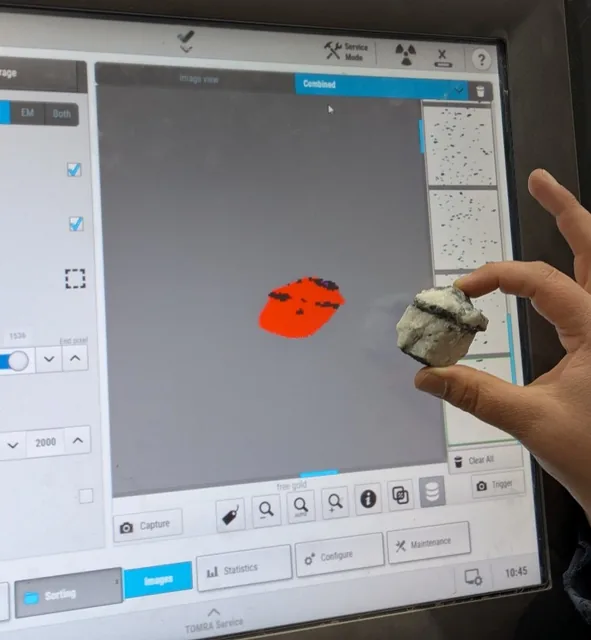
The tests demonstrated that the X-Ray Transmission (XRT) sorter alone achieved significant performance improvements. The XRT sorter rejected 57% to 67% of waste material, increased gold grades by 2.0x to 2.5x, and recovered 87% to 84% of total contained gold. The addition of a downstream laser sorter increased overall gold recovery to over 95%, but the recovered material was subeconomic. This led to a dilution of the overall grade of the sorted product, reducing the economic benefits of mass rejection during the Direct Shipping Ore (DSO) phase.
As a result, Talisker has decided to simplify the sorting circuit by removing the laser sorter. The revised XRT-only flowsheet is expected to maximize waste rejection, reduce the mass of shipped material, and lower transportation costs. The company anticipates that this will significantly increase gold grades, reduce capital equipment and construction costs by approximately $4 million CAD, and lower operating costs. Additionally, the simplified plant design will enhance overall operational efficiency.
The tests validated Talisker’s strategy of prioritizing mass reduction and grade enhancement to improve the economics of DSO shipments for the Bralorne Gold Project. The XRT sorter was found to be highly effective in selectively recovering dense sulphide-bearing material, which contains the majority of the high-grade gold, while rejecting lower-density, low-grade halo material. This approach is particularly well-suited for the Bralorne Gold Project, where the average true vein width is approximately 0.90 meters, and the average width of lateral development faces is 3.30 meters. The XRT sorter is interpreted to preferentially recover the high-grade vein core while rejecting much of the surrounding low-grade vein halo material, thereby reducing dilution and enhancing the recovery of dense sulphide-associated gold mineralization.
Talisker’s CEO, Terry Harbort, stated, "These results confirm we can achieve substantial waste rejection and significant gold grade increases while maintaining strong recoveries. The ability to eliminate the laser sorter and save approximately $4 million in capital costs, simplify the plant design and operations, and reduce operating costs further strengthens the economics of the Bralorne Gold Project."
The integration of ore sorting supports Bralorne's long-term development strategy by significantly reducing the volume of mineralized material requiring downstream transportation and processing. This has the potential to reduce the size, capital intensity, and operating costs of a future on-site milling facility, while providing greater flexibility for phased project development and capital allocation.