Stellerus Tech Showcases Innovative Climate Technologies at Eco Expo Asia 2026
News related to:Stellerus Tech · 2 min read
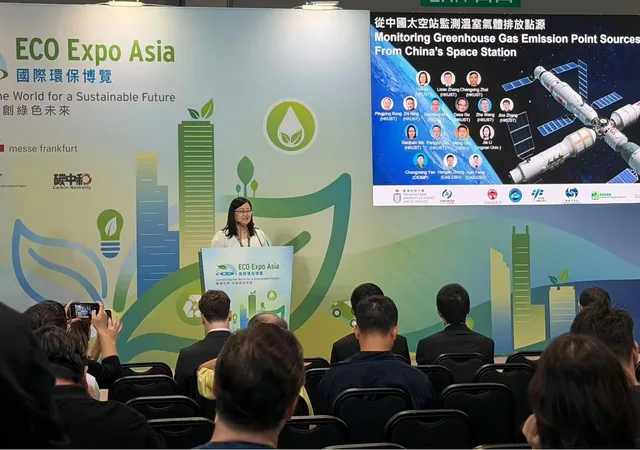
HONG KONG, Oct. 30, 2026 /CourierPR/ -- Stellerus Tech, an AI ClimateTech company incubated by the Hong Kong University of Science and Technology (HKUST), showcased its innovative technologies at Eco Expo Asia 2026, which took place from 26 to 29 October 2026 at AsiaWorld-Expo in Hong Kong. The expo focused on green technology innovation and sustainable development, highlighting Hong Kong's potential as a regional hub for green innovation.
At the event, Stellerus Tech presented its advanced technologies in extreme weather monitoring, urban flood forecasting, energy infrastructure resilience, marine environmental monitoring, and satellite remote sensing. These innovations demonstrate the potential of AI and satellite remote sensing technologies to enhance urban climate resilience and support the green transition.
The presentation introduced the MUSICO mission, developed by an HKUST research team and deployed aboard China's Tiangong Space Station in May 2026. MUSICO is capable of monitoring carbon dioxide (CO₂) and methane (CH₄) at a spatial resolution of approximately 100 meters, enabling the identification of individual emission sources. This capability provides more precise and objective observational data for emissions monitoring, verification, and carbon management.
Stellerus Tech also showcased its technological innovations and strategic vision in Physical AI and Earth intelligence services. He introduced the Feilian Constellation, a flagship project led by the company's co-founders. The constellation aims to establish a core meteorological data foundation for a global Earth intelligence platform, targeting 25 times higher global wind field resolution and more than a 20% improvement in forecast accuracy.
By combining satellite observations, meteorological models, and AI technologies, Stellerus Tech aims to build a next-generation Earth intelligence platform. This platform will provide accurate data and intelligent decision-making support for extreme weather forecasting, disaster risk early warning, renewable energy forecasting, and low-altitude aviation safety.
Five innovative technologies were showcased, demonstrating Stellerus Tech's ability to integrate multi-source environmental observations with Physical AI technologies. These applications include:
- Typhoon Wind Field Monitoring: The Hong Kong Coastal Typhoon Wind Field System features historical typhoon wind field replays, dynamic wind speed queries, and wind field analysis at different altitudes, supporting extreme weather monitoring and urban disaster preparedness. - 3D Urban Flood Digital Twin: By combining high-resolution terrain data, drainage networks, and 3D simulations, the system predicts flood areas and water depths during heavy rainfall, supporting road risk warnings and emergency flood response. - Typhoon Resilience for Energy Infrastructure: By combining typhoon tracks, wind forecasts, and power grid data, the system supports wind turbine shutdown decisions, substation flood risk assessments, and power load management, helping energy systems better withstand the impacts of extreme weather. - Marine Environmental Monitoring: Using 3D ocean current simulations, the system analyzes coastal current speeds, directions, and changes, supporting storm surge risk assessments, coastal flood prevention, and marine management. - Satellite-Based Slope Monitoring: By combining InSAR, optical satellite images, and ground-based GNSS sensor data, the system monitors slope movement and improves landslide early warnings.
Together, these five applications demonstrate Stellerus Tech's commitment to advancing climate risk management from environmental monitoring to predictive risk assessment and intelligent decision-making. As global climate challenges grow, AI, satellite remote sensing, and digital twin technologies are playing an increasingly important role in strengthening urban climate resilience and supporting the Green and Low-Carbon transition.