Sloth Move Analyzes Complex Address Changes After Home Moves
News related to:Sloth Move · 2 min read
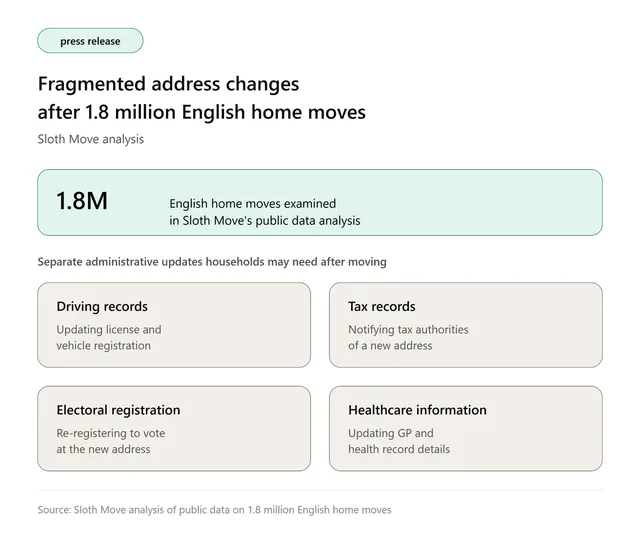
PETERBOROUGH, England, Sept. 23, 2026 /CourierPR/ -- Sloth Move, a change-of-address service based in Peterborough, UK, has released an analysis highlighting the fragmented nature of address changes after 1.8 million English home moves in 2024-2025. The analysis, which maps out the administrative steps required after a household relocates, underscores the complexity of the process and the need for careful coordination.
According to the English Housing Survey 2024-2025, approximately 1.8 million households moved in England during the period, with around half of these moves involving private rented dwellings. This figure provides a snapshot of residential mobility in the country, but the analysis by Sloth Move reveals that the practical work of moving extends far beyond the physical relocation itself.
The analysis focuses on the various records that need to be updated when a household changes address. These include driving records, tax records, electoral registration, and healthcare information. Each of these services operates according to its own rules and eligibility requirements, meaning that a change of address does not automatically update all relevant records.
For instance, the Driver and Vehicle Licensing Agency (DVLA) requires drivers to update their address on their driving licence and vehicle log book (V5C). GOV.UK guidance states that failure to do so can result in a fine of up to £1,000. Similarly, Her Majesty’s Revenue and Customs (HMRC) mandates that individuals notify the agency of a change of address to ensure that records related to Child Benefit, Income Tax, National Insurance, and State Pension are accurate.
Electoral registration operates separately, with people needing to register again with their new details if they change address. The online registration process is distinct from updating other public records, highlighting the need for movers to understand which services hold their address and which require a separate notification.
Sloth Move’s analysis also points to the importance of a coordinated approach to address management. The challenge is not simply entering a new address into a form but determining which organizations need the information, understanding the applicable process, and ensuring that the information reaches the correct record. This distinction is crucial for anyone navigating the administrative process of moving home.
The analysis does not estimate the number of organizations each household must notify or the time required for these updates. Instead, it provides a clear picture of the cumulative tasks created for households as they manage the wider demands of moving home. Sloth Move’s approach is based on using a single form to help movers communicate their new address to relevant organizations, while the receiving organizations continue to manage their own records and processes.
This distinction is important when assessing services designed to simplify moving-home administration. A service can reduce the number of separate interactions a mover has to manage without changing the underlying responsibilities of the organizations receiving the information. Sloth Move’s analysis highlights the need for movers to identify the records that apply to their circumstances and to check the official guidance applicable to their specific situation.
In summary, Sloth Move’s analysis underscores the complexity of moving home in England, particularly the need for careful coordination of various administrative tasks. The fragmented nature of address changes underscores the importance of understanding the specific requirements of each organization involved in the process.