RepRisk Reports Rise in Greenwashing Risk with Focus on Financial Services
News related to:RepRisk · 1 min read
ZURICH, Oct. 6, 2026 /CourierPR/ -- RepRisk, the world's most respected Data as a Service (DaaS) company for business conduct risks, has released its fifth annual Greenwashing Report, revealing a significant rise in greenwashing risk. In 2026, the number of companies linked to greenwashing reached 1,594, marking a 28% year-on-year increase. This follows a 12% decline in 2024 and a five-year increase of 112%. The report highlights that financial institutions remain at the center of this growing risk, with Financial Services recording a 40% year-on-year rise in the number of companies linked to greenwashing, while Banks saw a 23% increase.
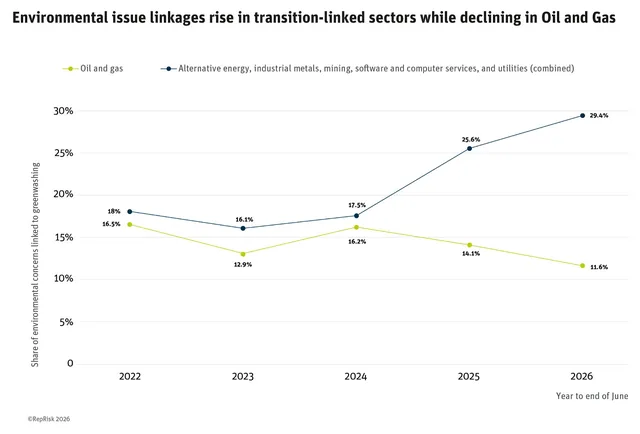
Transition-linked sectors have overtaken traditional high-emitting industries in terms of greenwashing risk. Alternative Energy, Industrial Metals, Mining, Software and Computer Services, and Utilities together accounted for 29% of greenwashing-related environmental issue linkages in 2026, up from 18% in 2022. In contrast, the share associated with Oil and Gas fell from 17% to 12%. Financial Services, the most exposed sector, saw 305 companies linked to greenwashing, a 40% increase from the previous year. Additionally, 86 Banks were linked to greenwashing, an increase of 23% year-on-year.
The environmental issues linked to greenwashing risk are also shifting. Between 2024 and 2026, greenwashing linkages concerning ecosystems and biodiversity nearly doubled from 162 to 300, while those concerning climate change and emissions remained broadly flat, edging up from 272 to 275. In 2026, biodiversity overtook climate as the leading environmental issue linked to greenwashing risk for the first time in five years.
Philipp Aeby, CEO and Co-founder of RepRisk, emphasized the importance of high-quality data in navigating the complex landscape of greenwashing.
The transition to a low-carbon economy is creating a new greenwashing risk landscape. As capital flows toward renewable energy, transition minerals, low-carbon infrastructure, and other climate solutions, scrutiny is increasingly extending beyond traditional high-emitting sectors to the activities intended to support the transition itself. RepRisk's data underscores the need for financial institutions to be vigilant and proactive in addressing these emerging risks.