Pearson Warns of Triple Capability Gap in Skilled Trades Due to AI Adoption
News related to:Pearson · 2 min read
SHANGHAI, Sept. 24, 2026 /CourierPR/ -- Pearson, the global learning company, has released a new report warning of a significant challenge in the skilled trades, technical, and service sectors as artificial intelligence (AI) adoption outpaces education and training.
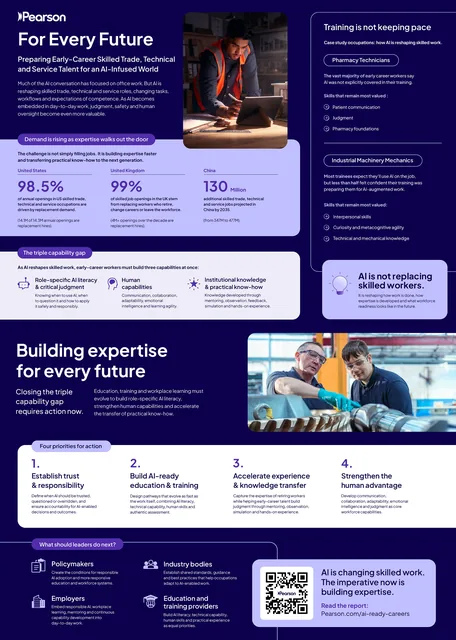
According to Pearson's research, a "triple capability gap" is emerging, where early-career workers in these fields are entering the workforce without the necessary skills to effectively integrate AI into their roles. This gap is driven by two primary factors: the rapid transformation of jobs by AI, which is outpacing the ability of education and training systems to adapt, and the retirement of experienced workers who are taking decades of practical knowledge with them.
The report highlights that AI is reshaping a wide range of jobs, not just those typically associated with the tech industry. For instance, pharmacy technicians and industrial machinery mechanics are finding their roles increasingly intertwined with AI. However, the necessary skills to safely and effectively apply AI in these roles are not yet adequately taught in current curricula. For example, one UK pharmacy industry participant noted that it takes 2-3 years to revise education and training standards for pharmacy technicians, while fewer than half of industrial machinery mechanics feel their training adequately prepares them for AI-enabled work.
The demand for skilled workers in these fields is rising, driven largely by the retirement of experienced workers. In the UK, 99% of skilled job openings stem from replacing workers who are retiring, changing careers, or leaving the workforce. In the US, the figure is 98.5%. This demographic shift is making it increasingly difficult for employers to maintain safety standards, sustain essential services, and support economic growth.
The report identifies three key capabilities that workers in these fields need to develop: the judgment to apply AI safely and effectively, human skills that AI cannot replace, and the hands-on expertise traditionally passed from one generation to the next. Closing these gaps requires a rethinking of how expertise is developed, with a focus on evolving education, training, and workplace learning to keep pace with the changing nature of these roles.
Sharon Hague, President of English Language Learning and UK CEO of Pearson, emphasized the urgency of addressing this challenge.
Pearson's research underscores the importance of developing a workforce that can combine these three capabilities. The company calls for a collaborative effort among educators, employers, and industry bodies to ensure that early-career workers are adequately prepared for the AI-infused world. The report also highlights the potential consequences of inaction, including difficulties in finding and developing the skilled workers needed, and the risk of expertise gaps affecting safety-critical occupations and essential services.
The findings of this report are particularly relevant as the world continues to integrate AI into various sectors. As AI transforms the nature of work, the need for a skilled and adaptable workforce becomes more critical than ever.