Motional Launches nuReasoning Dataset for Autonomous Vehicle Research
News related to:Motional · 2 min read
Motional, a leader in autonomous driving technology, has released the world’s first reasoning-centric, long-tail scenario open dataset, called nuReasoning, aimed at teaching autonomous vehicles (AVs) human-like reasoning and decision-making. The dataset, which includes over 20,000 long-tail scenarios, is designed to help AVs navigate complex edge cases by understanding spatial relationships, making driving decisions, anticipating risks, and considering alternative outcomes.
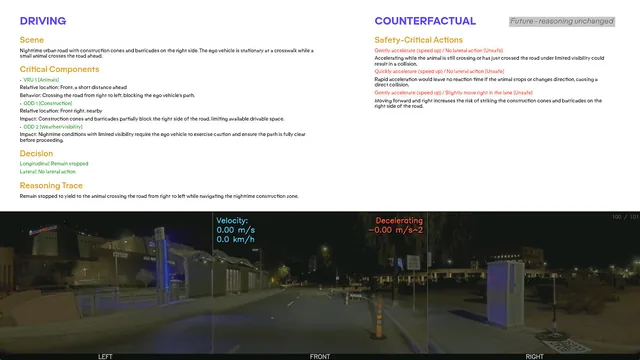
Developed in partnership with the University of California Los Angeles (UCLA) Mobility Lab, nuReasoning features unparalleled annotations. Each scenario, selected from Motional’s vast driving data, is accompanied by a video clip of at least 20 seconds, embedded with high-quality, human-verified reasoning. This allows researchers to understand not only what an AV perceives but also the logic behind specific actions and why alternative choices were deemed unsafe.
Motional has also launched the nuReasoning Challenge at the European Conference on Computer Vision (ECCV) in Sweden. This challenge invites researchers and practitioners to advance the next generation of driving foundation models by developing explainable trajectory and motion planning, as well as long-tail visual question answering and scene reasoning.
"The release of nuReasoning represents a significant step in advancing the safety and reliability of autonomous vehicles," said Phil Michel, Motional's Senior Vice President of Autonomy and AI. "By making this dataset openly available, we aim to contribute to the global research community and help solve complex, rare edge cases."
The nuReasoning dataset includes over 105 hours of carefully selected reasoning-intensive edge cases, such as unusual pedestrian activity, work zones, nighttime road construction, animal crossings, and limited visibility scenarios. It offers diverse reasoning annotations, supporting a broad range of vision-language-action (VLA) model training, including spatial reasoning, decision reasoning, and counterfactual reasoning.
Motional has integrated its proprietary Omnitag data search engine, which provides researchers with an intuitive navigation layer to query dataset distributions by scenario type, difficulty level, and location. Additionally, Omnitag enables powerful natural language semantic search, allowing users to search complex tactical interactions and instantly isolate matching data.
"nuReasoning extends Motional's legacy of advancing autonomous vehicle research through open data," said Michel. "By providing this dataset, we are offering a shared foundation to help the entire industry solve edge cases and advance toward scalable autonomous operation."