Magnes Rare Earths Reports Promising RC Drilling Results at Minas Americas
News related to:Magnes Rare Earths · 3 min read
Magnes Rare Earths, a subsidiary of Verde AgriTech Ltd., has announced significant assay results from the first reverse-circulation (RC) drilling at the Minas Americas Global Alliance project in Minas Gerais, Brazil. The drilling, conducted in partnership with the company, has extended the known mineralization depth and identified several high-grade intervals, highlighting the potential of the project.
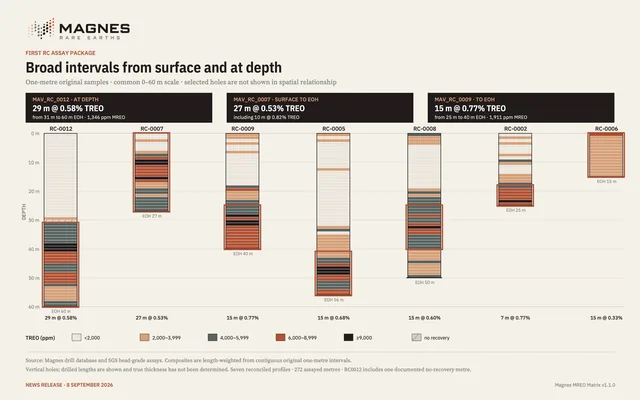
The RC drilling program, comprising seven holes, has returned promising results. MAV_RC_0012 stands out, delivering a 29-meter interval from 31 meters to 60 meters with an average grade of 0.58% total rare earth oxides (TREO) and 1,346 parts per million (ppm) magnet rare earth oxides (MREO). Within this interval, the company noted a particularly high grade of 6,636 ppm TREO and 1,561 ppm MREO over 14 meters. Additionally, two separate five-meter intervals between 38 meters and 51 meters yielded grades of 9,106 ppm TREO and 2,315 ppm MREO and 9,191 ppm TREO and 2,429 ppm MREO, respectively.
According to Cristiano Veloso, Founder and CEO of Magnes Rare Earths, "Today’s results give us the strongest combination yet of near-surface grade, depth, and magnet rare-earth content at Minas Americas. The 15 meters at 1.15% TREO from surface establishes a new full-hole benchmark for the project."
Auger drilling, which has been ongoing, has also contributed valuable data. MAV_AD_0375 returned the highest-grade full-hole result to date, with 15 meters from surface to the end of hole (EOH) averaging 11,480 ppm total rare earth oxides (TREO), or 1.15% TREO, and 2,830 ppm MREO. Within this interval, one meter from 12 meters to 13 meters returned a remarkable 19,952 ppm TREO (2.00% TREO) and 5,909 ppm MREO.
The presence of heavy rare-earth oxides (HREO) has also been noted, with MAV_RC_0012 returning 5 meters from 38 meters to 43 meters at 566 ppm HREO, including 100 ppm dysprosium-plus-terbium oxides. The RC results, averaging 145.5 ppm HREO across 272 assayed meters, including 29.8 ppm dysprosium and terbium, suggest a strong potential for heavy rare-earth recovery.
Veloso continued, "Rare-earth projects will ultimately be judged on recoverable magnet products, not head grade alone. The next value-defining work is to test beneath these current depth limits, connect the expanded dataset in three dimensions, and determine recoveries from representative drill composites. With 443 holes and more than 3.6 kilometers of reported assays, Minas Americas now has a substantially stronger platform for that work and for the planned maiden mineral resource estimate."
The company has now added 139 auger holes totalling 1,027 meters and seven RC holes comprising 272 assayed meters, bringing the cumulative reported assay drilling to 443 holes and 3,628.8 meters. The results extend the drill-derived dataset below auger depths and identify multiple broad, higher-grade intervals far below the reach of the auger program. Five of the seven RC holes returned elevated grades to EOH, with six ending above 4,000 ppm TREO in their final assayed meter.
The heavy rare-earth component, particularly dysprosium and terbium, has also been quantified. Across the 272 assayed RC meters, the magnet rare-earth oxides (MREO) average 828 ppm, or 22.8% of TREO, led by 798 ppm neodymium and praseodymium with 29.8 ppm dysprosium and terbium. These results, while head grades, do not establish desorbability or recovery. Representative drill-based metallurgical testwork is the next major step to determine how the magnet-oxide grades may translate into a recoverable product.
The International Energy Agency estimates that permanent magnets, which account for approximately 95% of global rare-earth consumption by value, will see a further one-third increase in demand by 2030 under current policy settings. The magnet oxides identified in the assays are critical components in the production of these magnets.
With the continuous expansion of the drilling dataset and the identification of multiple high-grade intervals, Magnes Rare Earths is positioning itself for a more comprehensive understanding of the mineral resource potential at the Minas Americas project.