Janitorial Wages Rise 26.7% Between 2020 and 2025
News related to:Nassco, Inc · 3 min read
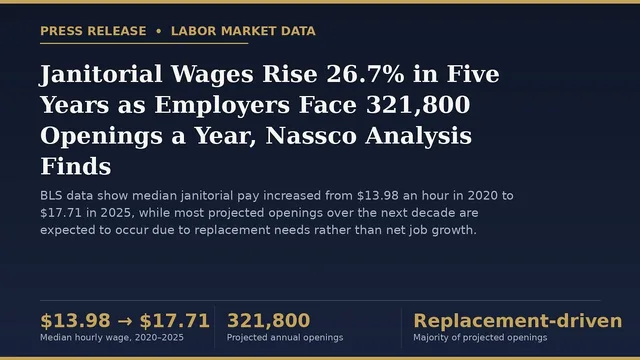
NEW BERLIN, Wis., Sept. 28, 2026 /CourierPR/ -- Nassco, Inc., a leading provider of janitorial services and equipment, has reported a significant increase in the median hourly pay for janitors and building cleaners, rising from $13.98 in 2020 to $17.71 in 2025, a 26.7% increase. This wage hike is part of a broader trend observed by the U.S. Bureau of Labor Statistics (BLS), which projects approximately 321,800 openings in the occupation each year from 2025 through 2035. The figures underscore the importance for facility managers to reassess their cleaning workload and staffing needs.
According to the BLS Occupational Employment and Wage Statistics, the national median hourly wage for cleaners and janitors, excluding maids and housekeeping cleaners, was $13.98 in May 2020. By May 2025, this figure had climbed to $17.71, equating to an annual median salary of $36,840. This wage increase is calculated from the two published median hourly wage figures and provides a national wage trend rather than a direct measure of individual facility costs.
The BLS also projects a modest 2% employment growth for janitors and building cleaners between 2025 and 2035. Employment is expected to increase from 2,432,600 jobs in 2025 to 2,486,200 in 2035, representing approximately 53,600 additional jobs. Despite the modest net growth, BLS projects about 321,800 openings per year over the decade, resulting from workers transferring to other occupations or leaving the workforce, including through retirement.
The variation in median hourly wages by employer category is also noteworthy. In May 2025, the BLS reported median hourly wages of $20.76 in government (excluding state and local education and hospitals), $18.63 in educational services, $18.35 in healthcare and social assistance, and $17.21 in services to buildings and dwellings. This variation underscores the importance of using facility-specific labor and workload information when evaluating floor-care operations.
In 2025, approximately 35% of janitors and building cleaners worked in services to buildings and dwellings, 17% in educational services, 7% in healthcare and social assistance, and 5% in government (excluding state and local education and hospitals). These environments can have very different floor areas, traffic patterns, cleaning frequencies, and operating schedules, which must be considered when selecting appropriate cleaning equipment.
The International Sanitary Supply Association (ISSA) provides guidance on calculating cleaning times, which can help facilities estimate their workload. In one ISSA example, a 14-inch flat mop with a dual-chamber bucket has a production rate of 5,355 square feet per hour. Under this setup, 1,000 square feet equates to approximately 11.2 minutes of cleaning time. ISSA describes its cleaning times as benchmarks that can support bidding, labor budgeting, and workloading, although actual results can vary by organization and operating conditions.
Nassco, Inc. offers several types of floor-cleaning equipment, including autonomous scrubbers, rider and stand-on scrubbers, walk-behind scrubbers, burnishers, floor machines, and sweepers. Equipment selection can start with the workload the facility needs to manage. Factors such as cleanable square footage, floor type, cleaning frequency, congestion, obstacles, route repeatability, staffing, storage, and charging requirements can help determine which type of equipment is appropriate for the space.
A walk-behind machine may be considered differently from a rider or stand-on machine when available floor area, maneuverability, and traffic conditions differ. Autonomous equipment introduces additional considerations, including route repeatability, operating environment, charging, and deployment. Service, maintenance, and training can also affect the practical suitability of equipment. Nassco's janitorial equipment service and repair program includes planned maintenance, replacement parts, installation, and training.
The 26.7% increase in the national median hourly wage between May 2020 and May 2025, according to the BLS, provides a measurable indicator of the change in the direct wage component of janitorial work. The BLS projection of 321,800 annual openings through 2035 provides separate context on recurring replacement activity. Neither statistic demonstrates that rising wages or replacement hiring causes facilities to purchase floor-cleaning equipment. However, they do provide a basis for examining how much labor is assigned to recurring floor-care tasks.
Facilities can begin by measuring cleanable floor area and cleaning frequency, identifying the tasks performed, estimating task time using appropriate production benchmarks, and comparing those requirements with actual staffing and labor costs. Equipment options can then be evaluated against the facility's physical and operational conditions. The result is a facility-specific approach to floor-care planning rather than an assumption that one equipment category or productivity rate applies to every site.