Hyundai Motor Group Unveils Data Flywheel Strategy for Autonomous Driving
News related to:Hyundai Motor Group · 2 min read
Hyundai Motor Group has unveiled a comprehensive strategy to accelerate its autonomous driving technology, emphasizing a virtuous cycle of data collection, AI training, validation, and deployment. The company showcased its dual-track approach, which includes the integration of NVIDIA solutions for Level 2+ production and the internal development of proprietary Atria AI technology.
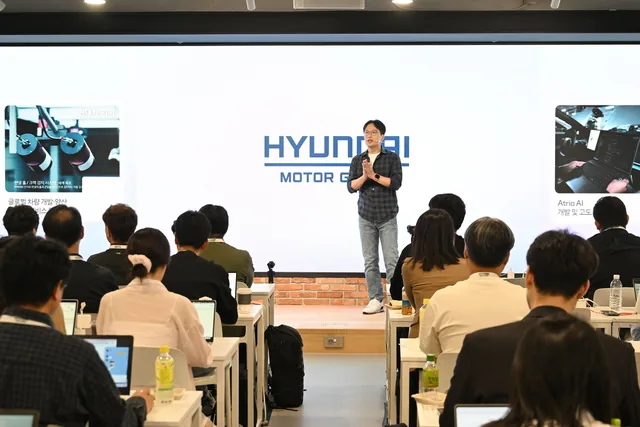
At the "HMG Autonomous Driving Media Day" held at 42dot headquarters in Gyeonggi Province, Korea, Hyundai Motor Group detailed its roadmap for the next era of autonomous driving. The event highlighted the company's commitment to advancing its autonomous driving capabilities through a robust data ecosystem and AI systems. According to Minwoo Park, President and Head of Advanced Vehicle Platform (AVP) Division at Hyundai Motor Group and CEO of 42dot, the Data Flywheel strategy is central to the group's autonomous driving competitiveness.
The Data Flywheel strategy involves collecting and analyzing vast amounts of real-world driving data to continuously improve AI capabilities. By leveraging its annual sales of 7 million vehicles, the group aims to establish a comprehensive data ecosystem. The Data Union framework, which integrates data from various sources, plays a crucial role in this strategy. The company also employs a data-centric development framework based on hard example mining, continuous training, and SER (Self-Explanatory Reporting) to ensure rapid learning and technological advancements.
Hyundai Motor Group plans to launch a real-world Level 4 pilot in Gwangju by the end of the year, in partnership with the Korea Ministry of Land, Infrastructure and Transport. This initiative will secure large-scale validation data, further enhancing the group's autonomous driving technology. Additionally, the company is focusing on the development of Vision-Language-Action (VLA) technology, which integrates visual information and language-based reasoning to guide driving decisions. The VLA research is aimed at addressing edge cases and enhancing the technical stability and scalability of autonomous driving systems.
During the event, the group demonstrated an Atria AI-equipped SDV Testbed navigating complex urban traffic without driver intervention. Operating at a Level 2++ capability, the autonomous driving system showcased the continuous cycle of learning, validation, and performance improvement enabled by the Data Flywheel. The footage is available on the group's official YouTube channel.
The dual-track strategy is designed to accelerate the production of Level 2+ vehicles through NVIDIA collaboration while internalizing key autonomous driving technologies through Atria AI. The company targets NVIDIA solutions-based Level 2+ production for the first half of 2028, followed by Level 2++ in the second half of the same year. Atria AI-powered Level 2++ vehicles are expected to be launched in the second half of 2029.
By focusing on data collection and AI training, Hyundai Motor Group aims to secure a competitive advantage in the autonomous driving technology landscape. The company's strategic positioning in the global autonomous driving technology competition underscores its commitment to developing autonomous driving technology that customers can trust. The goal is to ensure safety and quality levels that customers can rely on while continuously learning and improving.