Hitachi Rail Launches Enhanced by HMAX for Railway Systems
News related to:Hitachi Rail · 2 min read
BERLIN, Sept. 22, 2026 /CourierPR/ -- Hitachi Rail has announced a significant step in its digital transformation journey with the launch of 'Enhanced by HMAX™'. This initiative aims to embed advanced AI and data capabilities into the core of railway systems and operations worldwide, starting with all new rolling stock from 2027.
The company has committed to integrating proprietary HMAX sensor technology into its flagship trains, including the iconic ETR1000 high-speed train. These sensors will capture real-time data across critical systems, enabling operators to continuously monitor performance, identify emerging issues, and optimize maintenance and operations throughout the lifecycle of the asset.
HMAX for Rail is Hitachi Rail’s digital asset management platform, designed to integrate and harmonize data from trains, signaling systems, and infrastructure into a single, unified system. By leveraging advanced AI and real-time processing at the edge, the platform transforms how railway systems are managed, shifting from reactive approaches to predictive, data-driven decision-making.
At the InnoTrans event in 2024, Hitachi Rail unveiled HMAX, which is now installed on approximately 2,500 trains. The existing order pipeline will see this number expand to almost 3,500 HMAX installed trains in the coming years. The platform is expected to have a significant impact on the railway industry, as it aims to reduce total cost of ownership by extending asset life and minimizing unnecessary maintenance.
Approximately 50% of railway costs are attributed to maintenance and energy, and HMAX is designed to optimize these areas. In real-world deployments, the platform has already reduced some customers' maintenance costs by 15% and energy consumption by 15%. The company is now evolving its Operating Control Centers (iOCC) to enable deeper integration between operations and maintenance teams, closing the traditional gap between managing daily service delivery and long-term asset performance.
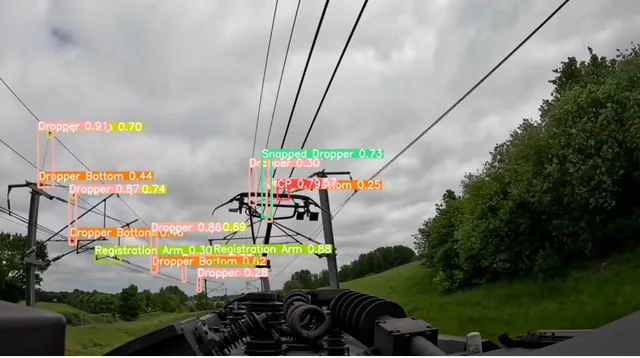
One of the key case studies involves HMAX Catenary Monitoring, which enables onboard computing to process the monitoring of overhead line equipment from cameras on in-service trains. Previously, processing a day’s footage could take up to 10 days due to manual data extraction and cloud processing. With NVIDIA IGX Thor deployed through HMAX, data is now analyzed in real time at the edge, with only potential faults transmitted for review. This real-time speed of monitoring enables Hitachi Rail’s customers to make far more impactful corrective decisions, while reducing any disruptions.
The platform is also supporting customers to develop autonomous tram programs. The tram systems combine next-generation autonomous positioning (NGAP), which achieves track location accuracy of under one meter, with obstacle detection, classification, and tracking (ODT) using a sensor fusion algorithm drawing on IMU, radar, LiDAR, stereo cameras, and GNSS. The AI models underpinning these capabilities were developed using simulated railway data that harnesses NVIDIA open Cosmos world model and NVIDIA Metropolis Blueprint for video search and summarization (VSS) to deploy contextually aware vision AI agents leveraging visual data from camera infrastructure. Additionally, NVIDIA Omniverse libraries enable the team to train against a wide range of scenarios, including rare, safety, or mission-critical events, without requiring years of live operational data collection.
The advantages of this approach are significant, including reduced ground-based infrastructure, lower installation and maintenance costs, increased passenger capacity, and improved energy efficiency through optimized speed profiles.