Great Plains Metals Corp Unveils Promising Historical Drill Intercepts at Goodrich
News related to:Great Plains Metals Corp · 1 min read
Great Plains Metals Corp announced significant findings at its Goodrich copper-gold project in New South Wales, Australia, on Monday, October 5, 2026. The company reviewed over 5,000 meters of historical drill records from the 1980s, revealing several notable mineralized intercepts that could inform the upcoming fully funded Stage 2 drill program.
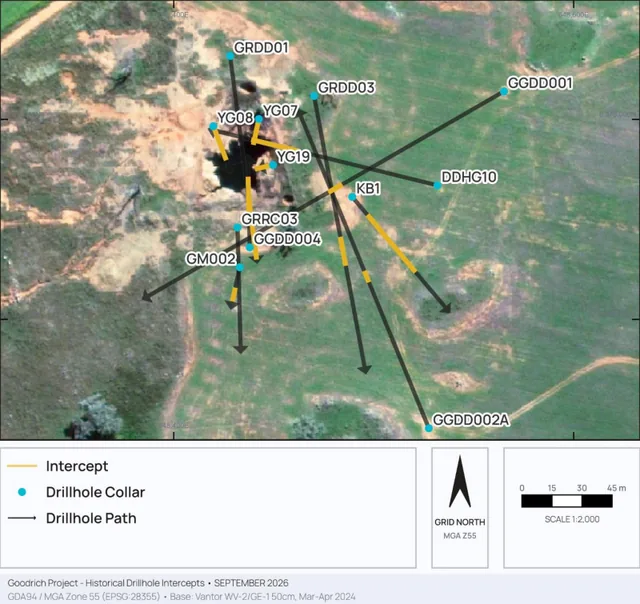
The review of the extensive historical data identified several key drill intercepts. For instance, diamond drill hole KB11 intersected 50.08 meters of 0.41% copper (Cu) and 0.32 grams per tonne (g/t) gold (Au). Similarly, diamond drill hole DDHG10 intersected 37 meters of 0.55% Cu and 0.17 g/t Au. Percussion drill hole YG08 also showed promising results, intersecting 33 meters of 0.65% Cu and 1.43 g/t Au.
Shallow mineralization was also identified at the surface. Multiple shallow percussion holes in the YG series, starting from just 1 meter deep, highlighted by 23 meters of 0.52% Cu and 0.73 g/t Au (YG07) and 15 meters of 0.33% Cu and 0.84 g/t Au (YG19) at the northern margin of the historic workings, provided further evidence of near-surface mineralization.
The company’s Stage 1 drill program, which included drillhole GGDD004, verified a continuous 128-meter intercept of porphyry-style mineralization, with 128 meters of 0.34% copper and 0.17 g/t gold. This finding builds upon the historical data and supports the potential for significant mineralization at the site.
Great Plains Metals Corp has also initiated a confirmatory resampling program of drill core archived at the W.B. Clarke Geoscience Centre, Londonderry Drillcore Library. A total of 94 one-meter half-core samples from historic holes KB1 and DDHG10 have been submitted for assay. Of particular interest is an unrecognized Unidirectional Solidification Texture (UST) zone from 26 to 33 meters in drillhole KB1, which assayed 0.77% Cu and 0.79 g/t Au, indicating the upper contact of a highly mineralized cupola.
These findings are part of a broader effort to re-evaluate the potential of the Goodrich project in light of current market conditions and the need for high-grade resources.