Global M&A Value Up 15% as Megadeals Drive Recovery
News related to:Boston Consulting Group · 3 min read
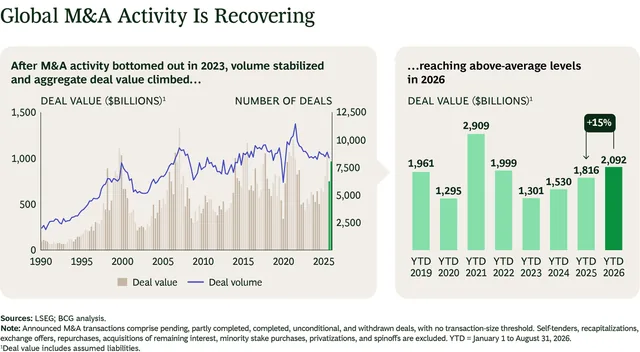
Global M&A activity strengthened further in the first eight months of 2026, with aggregate deal value rising 15% year over year and exceeding the ten-year average by 11%, according to a new report from Boston Consulting Group (BCG). The number of megadeals (transactions of $10 billion+) climbed to 37, up from 24 a year earlier and surpassing the record of 32 reached in 2021. However, deal volume below $1 billion remains below longer-term norms.
BCG's M&A Sentiment Index, which measures the near-term deal outlook, rose to 83 from 79, but still stands well below its long-term average of 100. The improvement in sentiment is uneven across sectors, with financial institutions and real estate showing the strongest sentiment at 108, health care at 100, and energy at 96. In contrast, the industrials, consumer, and technology sectors lagged, with sentiment readings of 66, 64, and 52, respectively. Despite the overall improvement, consumer deal value rose 20% year over year, while technology, media, and telecommunications remained the largest sector by aggregate deal value, up 11% year over year.
The rebound in M&A activity is concentrated at the top of the market, with megadeals driving the growth. According to Jens Kengelbach, global leader of Mergers & Acquisitions at BCG, the bottleneck has shifted to execution: finding transaction-ready assets, bridging valuation gaps, and clearing operational and regulatory hurdles. "The bottleneck has shifted to execution: finding transaction-ready assets, bridging valuation gaps, and clearing the operational and regulatory hurdles required to close. Until more deals pass those tests, the recovery will remain concentrated at the top of the market."
BCG identifies five key tests for assessing deal executability: asset readiness, market-clearing economics, resilient financing, organizational capacity, and regulatory clearance. Asset availability and economics are currently the most binding constraints on a broader recovery. Financing and organizational capacity are less restricted at the market level, although they still shape individual deals.
The rebound is regionally uneven, with North America leading global M&A activity by a wide margin, accounting for more than half of aggregate deal value. Europe posted the strongest percentage growth of any major region, while Asia-Pacific activity declined. Regulatory risk is shifting rather than receding, with national-security screening, foreign-investment controls, and foreign-subsidy reviews increasingly influencing deal terms, timing, and economics.
Portfolio rotation can broaden the recovery, with a greater number of divestitures, carve-outs, and private equity exits potentially increasing the supply of prepared assets and freeing up capital for higher-priority businesses. Alternative deal structures, such as minority investments, joint ventures, staged acquisitions, earnouts, and rollover equity, can help parties share valuation, technology, control, and regulatory risk. More dealmakers, especially in the AI ecosystem, are using these structures to get deals done.
AI is playing a dual role in the current cycle, encouraging new investment and deal activity in parts of the market while adding uncertainty around the durability of business models, revenue pools, and competitive positioning in others, making some assets harder to value and transact. A sharp correction in software company valuations earlier this year, together with a pullback in private-equity software deal activity, is an early sign of that dynamic.
The report offers several key insights, including the regional disparity in M&A activity, the shifting nature of regulatory risk, the potential for broader recovery through portfolio rotation, and the use of alternative deal structures to bridge uncertainty.