FFA Report Reveals Gaps in ASEAN Critical Minerals Trade
News related to:Fair Finance Asia · 2 min read
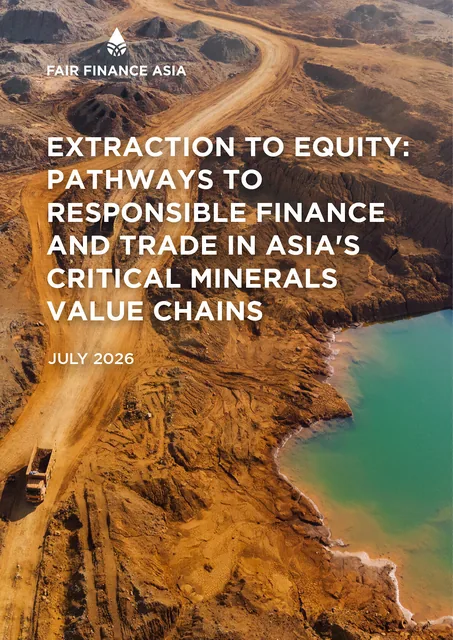
PHNOM PENH, Cambodia, Sept. 29, 2026 /CourierPR/ -- Fair Finance Asia (FFA) and its research partner, Profundo, have released a report titled "Extraction to Equity," which highlights significant gaps in the critical minerals trade and finance agreements among Association of Southeast Asian Nations (ASEAN) member states. The report, which draws on public information up to December 2025, reveals that local-benefits clauses, sustainability standards, and equitable value sharing are consistently missing from agreements and memoranda of understanding (MoUs) involving Cambodia, Indonesia, the Philippines, and Thailand.
According to the report, these countries are often left out of the value chains built on their critical minerals. The findings suggest that while source countries export raw minerals, the processing and value addition occur elsewhere, leaving the communities and environments at risk without the benefits they deserve. The report questions the extent to which this demand is driven by defense needs rather than renewable energy, and whose interests are being prioritized.
Bernadette Victorio, Program Lead at FFA, emphasized the importance of mapping out the terms before communities can demand fair treatment.
Juliette Laplane, a Senior Researcher at Profundo, highlighted the need for critical minerals agreements to move beyond mere market access.
Sophoan Phean, National Director at Oxfam in Cambodia, warned that Cambodia is at an early stage of critical mineral development and must prioritize community rights, environmental protection, and revenue transparency and accountability.
Victoria Fanggidae, Executive Director of The PRAKARSA, called on banks and investors to make human rights due diligence, community consent, transparent benefit-sharing, and credible decarbonization conditions of finance.
Yuki Tanabe, Program Director at the Japan Center for a Sustainable Environment and Society, urged major Japanese banks and companies involved in the mining, refining, processing, and procurement of critical minerals in Southeast Asia to strengthen their Environmental, Social, and Governance (ESG) standards.
Joel Chester Pagulayan, Climate Justice Portfolio Manager at Oxfam Pilipinas, emphasized the need for ASEAN and national regulators to replace voluntary commitments with mandatory safeguards that advance community rights, free, prior, and informed consent (FPIC), and equitable development.
Ponpakin Phruttiwongwanit, Project Coordinator at Fair Finance Thailand, stressed the urgency of closing policy gaps to protect people and ecosystems at the frontline of extraction.
The report calls on ASEAN member states and financial regulators to incentivize alternatives to extractivism and endorse the UN Principles to Guide Critical Energy Transition Minerals Towards Equity and Justice.