CMS Final Rule Tightens Prior Authorization Timelines for Health Plans
News related to:BHM Healthcare Solutions · 3 min read
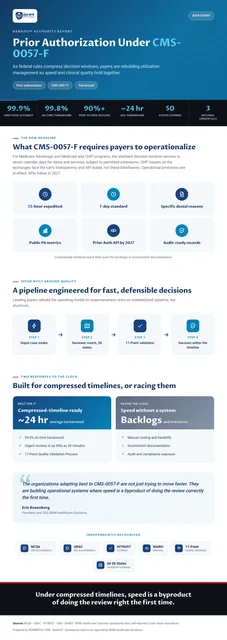
TAMPA, FL, Sept. 19, 2026 /CourierPR/ -- Prior Authorization Final Rule (CMS-0057-F) has reshaped the landscape for health plans and managed care organizations, setting tighter timelines and new transparency obligations. The rule, which took effect in 2026, mandates that standard prior authorization decisions for items and services be completed within seven calendar days, with a 72-hour expedited timeframe for urgent requests. This compressed timeline is part of a broader initiative to improve the efficiency and accuracy of medical necessity determinations, aligning with federal and state expectations for faster, more transparent, and defensible decisions.
According to guidance from the Centers for Medicare & Medicaid Services (CMS), the operational provisions of CMS-0057-F have significantly impacted how health plans manage their prior authorization processes. The rule applies to Medicare Advantage organizations, state Medicaid and Children’s Health Insurance Program (CHIP) fee-for-service programs, and Medicaid and CHIP managed care entities. While Qualified Health Plan issuers on the federally facilitated exchanges are subject to other provisions, including denial-reason, public reporting, and application programming interface requirements, they are not bound by the decision-timeframe requirements.
BHM Healthcare Solutions, a leading independent review organization, has adapted to these changes by building a robust operating model that prioritizes both speed and quality. The company reports an average review turnaround of approximately 24 hours, with urgent reviews completed in as little as 30 minutes when clinically indicated. BHM maintains a nationwide physician reviewer network with licensure coverage across all 50 states, ensuring consistent and specialized clinical criteria are applied. Its standard medical review workflow incorporates a proprietary 17-Point Quality Validation Process, designed to keep documentation consistent and decisions defensible even under compressed timelines.
The practical effect of CMS-0057-F is a compressed timeline that leaves less room for backlogs, manual handoffs, and inconsistent documentation. This has exposed operational gaps in organizations that depend on limited reviewer capacity, manual case routing, or inconsistent clinical criteria. Healthcare leaders are increasingly focused on ensuring their organizations can sustain expedited and standard decision timelines during volume spikes. Key questions include whether the organization can maintain quality during peak volumes, document medical necessity determinations consistently, ensure reviewer capacity across required specialties, and balance concurrent and retrospective review services.
The cost of backlogs is significant, as delayed determinations can postpone care, frustrate providers, and generate downstream call volume and grievances. Under compressed timelines, a backlog is no longer just an efficiency problem but a compliance issue. Many organizations now treat utilization management backlog solutions as a core capability, leveraging scalable reviewer networks, standardized workflows, and purpose-built software to absorb elevated volume without extending turnaround or relaxing clinical standards.
The rule also requires the implementation of standardized application programming interfaces (APIs), including a Prior Authorization API, by 2027. The intent is to automate the exchange of documentation, reducing manual back-and-forth and improving the efficiency of the review process. Organizations that treat the API mandate as an operational upgrade, rather than a compliance checkbox, tend to capture the turnaround benefits the rule was designed to produce. Clean, structured documentation is crucial, as automated exchange only helps if the underlying determination and its rationale are complete and consistent.
For providers and members, faster decision requirements are meant to benefit the patient experience. Timely determinations reduce delays in care, shorten the window of uncertainty, and provide quicker answers to providers. However, the risk is that an organization may meet the clock while weakening the underlying decision, shifting burden onto providers through avoidable denials and onto members through appeals. Payers that pair speed with documented quality protect the member experience the rule was designed to improve.
Implementation of CMS-0057-F is a people and process question as much as a technology one. Plans are examining reviewer capacity across specialties and states, the specificity of denial language, the consistency of clinical criteria across review types, and the reporting needed to demonstrate compliance. Many are also deciding what to keep in-house and what to support through an external partner. The organizations making the smoothest transitions treat these as connected decisions, aligning capacity, criteria, documentation, and reporting into a single operating model rather than addressing each in isolation.
The future of prior authorization is likely to continue evolving. Federal and state expectations continue to move toward faster, more transparent, and more defensible medical necessity decisions. Additional rulemaking, such as the proposed CMS-0062-P, signals continued momentum. Organizations that can substantiate their operational performance with clear, evidence-based information are better positioned to meet the scrutiny that accompanies these expectations.