Beyond Diagnosis - New Digest Connects Breast Cancer Science With Young Women’s Lives: 20 perspectives on biology, timely diagnosis, fertility, and lifelong care
News related to:Breast Cancer in Young Women Foundation · 3 min read
Breast cancer in young women raises questions that extend well beyond the tumor. Why does cancer develop in early adulthood? How well does existing research reflect younger patients? What happens when diagnosis and treatment intersect with fertility, careers, relationships, and decades of future health?
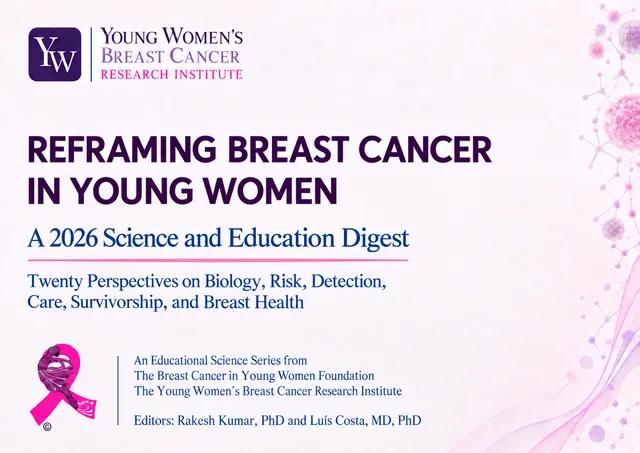
A publication from the Breast Cancer in Young Women Foundation (BCYW Foundation) and the Young Women’s Breast Cancer Research Institute (YWBCRI) brings these questions together in one conversation. “Reframing Breast Cancer in Young Women: A 2026 Science and Education Digest,” edited by Rakesh Kumar, PhD, and Luís Costa, MD, PhD, brings together twenty perspectives that link scientific evidence to the needs of young women.
Its central message is that progress requires coordination. Earlier detection, more precise research, individualized treatment, and sustained support depend on services that work together. A promising discovery or greater awareness can have limited impact if timely evaluation, treatment, or follow-up remains difficult to access.
The collection begins with a fundamental question for interpreting evidence: whom does the research describe? “Young women,” “early-onset,” and “premenopausal” identify overlapping populations, but they do not denote identical biological or clinical circumstances. Findings from broad age groups may obscure distinctions relevant to women under 40.
The digest calls for clearer definitions, meaningful participation of younger women in clinical studies, and age-specific reporting. It also cautions against treating breast cancer in young women as a single disease. Tumor characteristics, inherited susceptibility, ovarian function, and individual circumstances remain essential to understanding each diagnosis.
“A breast cancer diagnosis early in adulthood raises questions that can last a lifetime,” said Kumar, Founder and President of BCYWF and Scientific Director of YWBCRI. “Research must ensure that younger women are represented in the evidence, and health systems must address their needs—from the first concern through treatment and survivorship.”
Across its scientific perspectives, the publication examines inherited risk beyond BRCA, metabolic health, environmental and lifestyle exposures, and opportunities for prevention throughout early life. It encourages readers to distinguish established findings from emerging hypotheses and to separate population-level associations from explanations for an individual woman’s cancer. Prevention education should inform choices without implying that every cancer is preventable or assigning blame to those who develop the disease.
The same attention to evidence guides discussions about early detection. Awareness matters, but so do clinical listening, diagnostic capacity, referral pathways, affordability, and follow-up. A young woman’s ineligibility for routine screening should never be a reason to dismiss a concerning symptom.
Articles on risk prediction, artificial intelligence, imaging, and biomarkers consider both scientific promise and practical utility. Emerging approaches need validation and a place within services that can provide further investigation and treatment. Innovation becomes meaningful when women can access appropriate care.
The digest also examines the consequences of diagnosis in early adulthood. Fertility and reproductive goals may prompt urgent decisions. Mental health, sexual health, employment, identity, and family responsibilities can affect treatment experiences and recovery.
Support may be needed for decades after treatment. Women living with metastatic disease face ongoing therapy, uncertainty, and evolving practical needs. Both experiences require care that evolves over time.
“Chronological age is a starting point, not a complete clinical description,” said Costa. “Tumor biology, inherited susceptibility, ovarian function, and reproductive goals can vary substantially among women of the same age.”
The final perspectives address global disparities, universities as settings for breast health education, coordinated care pathways, and health strategy. They ask how researchers, educators, healthcare teams, community organizations, and policymakers can translate knowledge into accessible services. Young women’s experiences and priorities are central to that effort.
Summarizing twenty LinkedIn Pulse articles, the digest offers key insights, selected references, and links to the original articles. It is intended for young women, families, healthcare professionals, researchers, educators, and advocates.
ACCESS THE EVIDENCE DIGEST The digital book is available without charge through the websites of both organizations: Young Women’s Breast Cancer Research Institute ywbcri.org Direct book link: breastcancerinyoungwomen.org/docs/evidence-education-library/reframing-breast-cancer-young-women.pdf Breast Cancer in Young Women: Resources, Evidence and Education Library breastcancerinyoungwomen.org/resources
EDUCATIONAL DISCLAIMER: These publications provide educational summaries and perspectives. For complete study data, methodology, and interpretation, readers should consult the cited original publications. This information is provided for educational purposes only and does not substitute for professional medical advice. Readers should consult a doctor with any concerns or questions.