Au Gold Corp Identifies Two High-Priority Drill Targets in Havelock Project
News related to:Au Gold Corp · 3 min read
Au Gold Corp has identified two high-priority drill targets at its Havelock Gold-Antimony project in Victoria, Australia. The company is excited about these targets, which are part of the Shaw-McFarlane Trend, a historically productive gold belt from the 1800s.
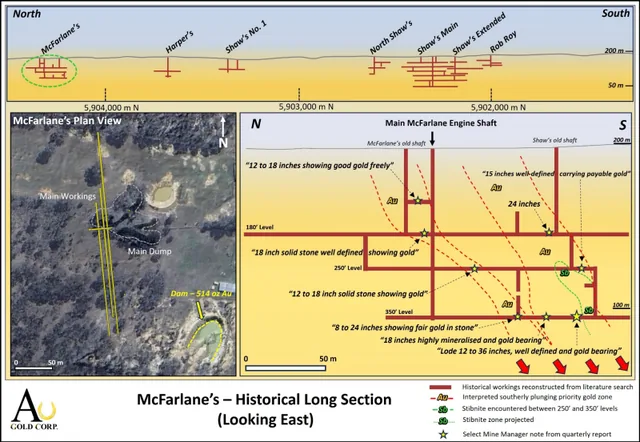
The first target, McFarlane, is based on historical records from the 1880s that describe ultra-high-grade gold-antimony mineralization. The records indicate that gold grades in the multi-ounce per ton range were mined and processed, with an estimated average grade of about 23 grams per tonne (g/t) gold. The mining ceased when antimony was encountered at lower levels, mixed with the gold in quartz, and combined with difficulties in pumping out groundwater.
The second target, Shaw’s No. 1 North, is located in the central part of the significant workings on the Shaw-McFarlane Trend. Historical records show that gold-bearing reef mineralization was documented throughout the majority of the workings. The company plans to systematically target the region directly beneath the 180-foot (55 meters) level of the historic mine to determine the continuity of mineralization and establish the potential plunge geometry of mineralized shoots. Drill holes will also test the parallel reef east of the main Shaw No. 1 workings.
Marc Blythe, Founder & CEO of Au Gold Corp, commented, "We are extremely excited to have identified these two high-priority targets along the Shaw-McFarlane Trend, which was a productive gold belt in the 1800s. The first targets announced in this release are the McFarlane historical gold-antimony mineralization and the nearby 514 ounces of gold reportedly recovered from the Dam target in 2010, both of which initially drew AUGC to this project."
The McFarlane target is of particular interest due to its historical significance. The records indicate that the most interesting quartz vein widths are depicted by yellow stars, with the mine manager's comments in quotes. The 350-foot (107 meters) level recorded some of the thickest vein dimensions of the entire trend, at 36 inches (0.91 meters). The occurrence of antimony mineralization is best documented at this level, described as being much larger than anticipated.
The Shaw’s No. 1 North target is located in the central part of the significant workings on the Shaw-McFarlane Trend. The plan view map illustrates a parallel mineralized reef roughly 10 meters east of the main Shaw No. 1 workings, which is believed to have been worked in a lesser capacity by earlier miners. The mineralized system at Shaw’s No. 1 strikes north and is interpreted to dip steeply to the west. The strongest mineralization documented historically covers a horizontal span at the 180-foot level of approximately 55 meters. The company will systematically target the region directly beneath this portion of the 180-foot level to determine the continuity of mineralization and establish the potential plunge geometry of mineralized shoots.
Au Gold Corp continues to prepare for diamond drilling on the Shaw-McFarlane Trend and other peripheral targets. The company is in active discussions with private landowners regarding access to the drill targets, which require permission from these landowners. The historical records used to identify these targets have been compiled from public records, including public company disclosures and newspaper articles from the late 1800s. The company cautions that these records may contain inaccuracies and may be incomplete in areas.
Technical information in this press release was prepared under the supervision of Mr. William Wengzynowski, P.Eng., a Qualified Person as defined by NI 43-101. Wengzynowski is Au Gold Corp’s Exploration Manager.