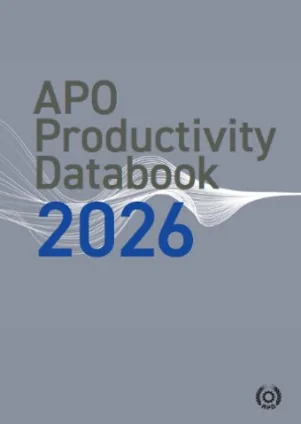
APO Releases 19th Edition of Productivity Databook 2026
News fromCourierPR · 2 min read
TOKYO, Oct. 07, 2026 /CourierPR/ -- The Asian Productivity Organization (APO) has released the 19th edition of the APO Productivity Databook, which provides a comprehensive look at economic growth and productivity trends across 38 Asian economies from 1970 through 2024, with projections through 2035. This edition presents labor productivity indicators for the 21 APO member economies (APO21) and 17 nonmember economies, collectively referred to as Asia38.
According to the Databook, average annual growth in per-hour labor productivity moderated from 2.9% in 2015-2019 to 2.5% in 2019-2024. Meanwhile, average annual total factor productivity (TFP) growth remained steady at 1.0% in both periods. The Databook further examines changes in productivity, industrial structure, and the composition of demand within and across APO member economies.
The 2026 edition incorporates revisions to official national accounts and related statistics released up to May 2026. It also builds on the APO Productivity Database 2026, which includes quality-adjusted labor input estimates from the Asia Quality-adjusted Labor Input Database 2026 and stock estimates of land and mineral and energy resources from the Asia Natural Resources Database 2026. The database provides regional productivity accounts for various groups, including ASEAN6, APO21, Asia28, CLMV (Cambodia, Lao PDR, Myanmar, and Vietnam), East Asia, and SAARC (South Asian Association for Regional Cooperation).
At current exchange rates, Asia38’s GDP reached USD40.3 trillion in 2024, marking a 37% increase from the US GDP. Asia38’s real GDP grew by an average of 3.8% per year in 2019-2024, with China and India contributing 1.8 and 0.8 percentage points, respectively. Several Asia28 economies recorded strong recent productivity growth, with per-hour labor productivity growing by 3.7% per year in 2019-2024. The highest growth rates were recorded in China at 5.8%, Vietnam at 4.5%, India at 4.4%, and Bangladesh at 3.9%.
The Databook’s growth-accounting results show that capital input accounted for 57% of Asia28’s economic growth over 2000-2024, while TFP contributed 28%. Capital deepening accounted for about 45% of Asia28’s labor productivity growth. Provisional estimates indicate that Asia38 accounted for 50% of world final energy consumption and 60% of world CO2 emissions from fuel combustion in 2024.
Saudi Arabia is included in the full productivity accounts for the first time, bringing the number of economies covered to 28. Kazakhstan, Kyrgyzstan, Tajikistan, Turkmenistan, and Uzbekistan are newly included in the broader labor productivity indicators, bringing that coverage to 38 economies. The 2026 edition strengthens the evidence available to policymakers, researchers, and practitioners developing productivity strategies by providing a stronger, comparable measurement based on harmonized national accounts, quality-adjusted labor input, detailed capital services, and stock estimates of land and mineral and energy resources.
The APO Productivity Databook 2026 is available in both digital and print formats and can be accessed and downloaded for free from the link provided. The APO Productivity Database 2026, which contains full productivity accounts for APO21 and seven nonmember economies, is available at the APO's website.