AI's energy demands expose grid limitations prompting innovation
News provided byNosTerra Venture Capital · 3 min read
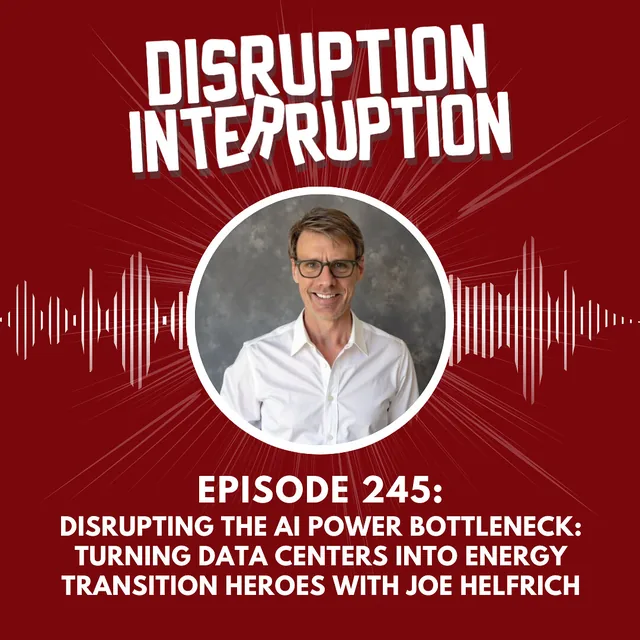
In an interview with Karla Jo Helms on the podcast "Disruption Interruption," Joe Helfrich, Managing Partner and Co-Founder of NosTerra Venture Capital, discusses how the surge in AI's power demands is exposing the limitations of the energy grid and how innovation could transform data centers into accelerators of cleaner energy.
According to the U.S. Department of Energy, U.S. data center energy use is expected to double or triple by 2028, potentially consuming up to 12% of the nation's total electricity. As AI adoption grows, the bottleneck is no longer technical limitations but the infrastructure that supports energy generation, transmission, storage, and cooling.
Helfrich, a key player in the AI infrastructure space, argues that data centers are not just energy consumers but also potential drivers of innovation. "The demand is still outstripping capacity," he said. "The current energy grid can't meet that need, but this presents an opportunity to rethink and innovate around energy infrastructure."
The AI infrastructure problem extends beyond data centers. As AI workloads grow, the pressure is felt across the entire energy ecosystem, including generation, transmission, and storage. Helfrich notes that this has led to data centers being viewed as energy villains, straining local grids and raising concerns about water use and resource competition. However, he believes this perspective captures only part of the picture. "Data centers really could be a challenge to energy innovation," Helfrich explained. "We take a contrary view and think this is a unique opportunity."
As AI moves from centralized model training to real-time applications, the issue will become more complex. The need for compute to occur closer to the end user is critical, especially in applications like autonomous vehicles and industrial systems. "They're not going to wait for that inference to go across the country," Helfrich said. "The delays can be significant."
NosTerra Venture Capital is investing in physical-layer solutions to address these challenges. Helfrich sees AI's power crunch as an opportunity for companies developing technologies in generation, transmission, storage, and data center power usage. "It's going to be an all-of-the-above solution," he said. "Data centers are really just factories that take energy and convert it into compute."
One example is a Boston-area company out of MIT that uses carbon-capture technology inside modular edge data centers. This system improves cooling efficiency while producing beverage-grade CO2 as a byproduct, which can then be sold to bars and restaurants. The revenue can help support the economics of the facilities powering AI workloads. "It's that crazy out-of-the-box thinking," Helfrich said, "solving two problems at one time."
For Helfrich, the pressure on data centers can also be a driver of innovation. The demand for compute creates customers, urgency, and capital for energy technologies that might otherwise move slowly. "This is not about AI," he said. "These innovations can make energy more abundant, resilient, and available across the economy."
NosTerra evaluates companies based on their ability to solve urgent infrastructure problems, not just incremental improvements. "We look for technologies that can materially change capacity, cost, or speed to market," Helfrich said. "The strongest opportunities are the ones that are mind-blowing and out-of-the-box."
Helfrich's perspective is that the same pressure that makes data centers controversial could also make them useful. "The innovations these centers drive can have a significant impact on the energy landscape," he concluded.
In an increasingly energy-conscious world, the role of data centers in driving clean energy solutions is becoming more critical. As AI adoption continues to grow, the focus shifts from simply consuming energy to actively contributing to a more sustainable and resilient energy ecosystem.