82.6% of IT budget and 66% of staff time go to maintaining systems, report shows
News provided byInfo-Tech Research Group · 2 min read
Arlington, Va., Sept. 4, 2026, A significant portion of IT budgets and staff time is dedicated to maintaining existing systems, leaving limited resources for innovation and operational improvements. According to Info-Tech Research Group, 82.6% of IT spend and 66% of staff time are committed to keeping the lights on (KTLO), with only a small fraction available for new initiatives and strategic growth.
To address this imbalance, Info-Tech Research Group has published a new blueprint titled "Harness AI to Reduce the Cost and Effort of KTLO in IT Operations." The resource aims to help Chief Information Officers (CIOs) identify and implement AI-enabled strategies that can reduce KTLO burdens, reclaim capacity for higher-value work, and build practical AI skills.
Info-Tech Research Group's Principal Research Director, Fred Chagnon, emphasized the outdated mindset surrounding KTLO. "Targeted AI investments can help CIOs reduce low-value manual work, reclaim budget and staff time, and reinvest both in innovation," he said. "The result is an IT organization that runs smarter and has more capacity to deliver value."
However, the report cautions against common cost-cutting responses. Running hardware and software beyond their end of life can increase technical debt and security risks. Using outsourcing primarily for cost reduction can overlook its value in reclaiming capacity and accessing specialized expertise. Eliminating growth or transformation initiatives can starve the business of future value.
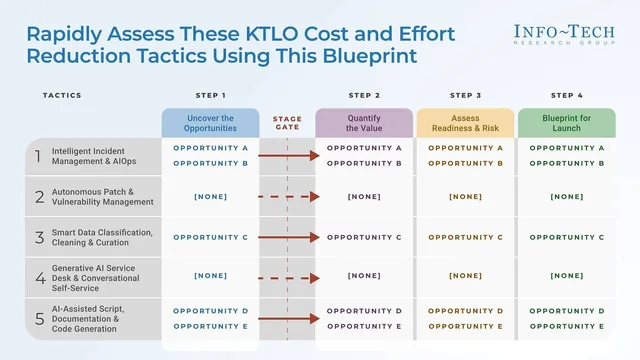
The blueprint outlines five AI tactics that IT leaders can assess based on their operational priorities, technology environment, and organizational readiness: 1. Intelligent Incident Management and AIOps: Detect anomalies, correlate events across operational silos, support predictive maintenance, and automate common remediation activities. 2. Autonomous Patch and Vulnerability Management: Automate patch prioritization, deployment, and verification to reduce manual effort and support more consistent compliance. 3. Smart Data Classification, Cleaning, and Curation: Reduce duplicate and outdated data, storage bloat, and manual data management while strengthening the governed data foundation required for AI. 4. Generative AI Service Desk and Conversational Self-Service: Deflect routine Tier 1 requests, improve access to support, and free service desk staff to focus on more complex work. 5. AI-Assisted Script, Documentation, and Code Generation: Accelerate scripting and documentation, preserve knowledge about legacy systems, and reduce the effort required to maintain them.
Info-Tech's four-step framework for AI-enabled KTLO reduction helps CIOs evaluate potential use cases: 1. Uncover Opportunities: Identify manual, repetitive, and resource-intensive KTLO activities that could benefit from AI and automation. 2. Quantify the Value: Estimate the labor time and costs associated with each activity, then project potential cost reductions, reclaimed effort, and time to value. 3. Assess Readiness and Risk: Evaluate organizational constraints such as data quality, integration requirements, process maturity, skills, change readiness, and implementation risk. 4. Blueprint for Launch: Define viable initiatives, accountable teams, expected outcomes, and actionable milestones, then consolidate them into a Quantified KTLO Reduction Initiative Portfolio.
KTLO reduction can also serve as a workforce development opportunity. Applying AIOps, automation, and generative AI to familiar, measurable processes gives IT teams practical experience in a controlled environment and prepares them to lead broader AI initiatives across the organization.
By connecting projected cost and effort reductions with readiness, risk, time to value, and implementation milestones, the research helps leaders move KTLO discussions from short-term cost cutting to measurable reinvestment in innovation.