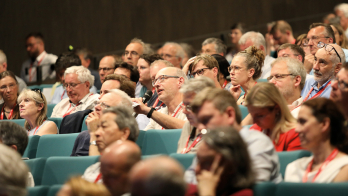
Once a year, the International Committee for Future Accelerators (ICFA) assembles for an in-person meeting, typically attached to a major summer conference. The 99th edition took place on 24 August at the Wisconsin IceCube Particle Astrophysics Center in downtown Madison, one day before Lepton–Photon 2025.
While the ICFA is neither a decision-making body nor a representation of funding agencies, its mandate assigns to the committee the important task of promoting international collaboration and coordination in all phases of the construction and exploitation of very-high-energy accelerators. This role is especially relevant in today’s context of strategic planning and upcoming decisions – with the ongoing European Strategy update, the Chinese decision process on CEPC in full swing, and the new perspectives emerging on the US–American side with the recent National Academy of Sciences report (CERN Courier September/October 2025 p10).
Consequently, the ICFA heard presentations on these important topics and discussed priorities and timelines. In addition, the theme of “physics beyond colliders” – and with it, the question of maintaining scientific diversity in an era of potentially vast and costly flagship projects – featured prominently. In this context, the importance of national laboratories capable of carrying out mid-sized particle-physics experiments was underlined. This also featured in the usual ICFA regional reports.
An important part of the work of the committee is carried out by the ICFA panels – groups of experts in specific fields of high relevance. The ICFA heard reports from the various panel chairs at the Wisconsin meeting, with a focus on the Instrumentation, Innovation and Development panel, where Stefan Söldner-Rembold (Imperial College London) recently took over as chair, succeeding the late Ian Shipsey. Among other things, the panel organises several schools and training events, such as the EDIT schools, as well as prizes that increase recognition for senior and early-career researchers working in the field of instrumentation.
Maintaining scientific diversity in an era of potentially vast and costly flagship projects featured prominently
Another focus was the recent work of the Data Lifecycle panel chaired by Kati Lassila-Perini (University of Helsinki). This panel, together with numerous expert stakeholders in the field, recently published recommendations for best practices for data preservation and open science in HEP, advocating the application of the FAIR principles of findability, accessibility, interoperability and reusability at all levels of particle-physics research. The document provides guidance for researchers, experimental collaborations and organisations on implementing best-practice routines. It will now be distributed as broadly as possible and will hopefully contribute to the establishment of open and FAIR science practices.
Formally, the ICFA is a working group of the International Union for Pure and Applied Physics (IUPAP) and is linked to Commission C11, Particles and Fields. IUPAP has recently begun a “rejuvenation” effort that also involves rethinking the role of its working groups. Reflecting the continuity and importance of the ICFA’s work, Marcelo Gameiro Munhoz, chair of C11, presented a proposal to transform the ICFA into a standing committee under C11 – a new type of entity within IUPAP. This would allow ICFA to overcome its transient nature as a working group.
Finally, there were discussions on plans for a new set of ICFA seminars – triennial events in different world regions that assemble up to 250 leaders in the field. Following the 13th ICFA Seminar on Future Perspectives in High-Energy Physics, hosted by DESY in Hamburg in late 2023, the baton has now passed to Japan, which is finalising the location and date for the next edition, scheduled for late 2026.