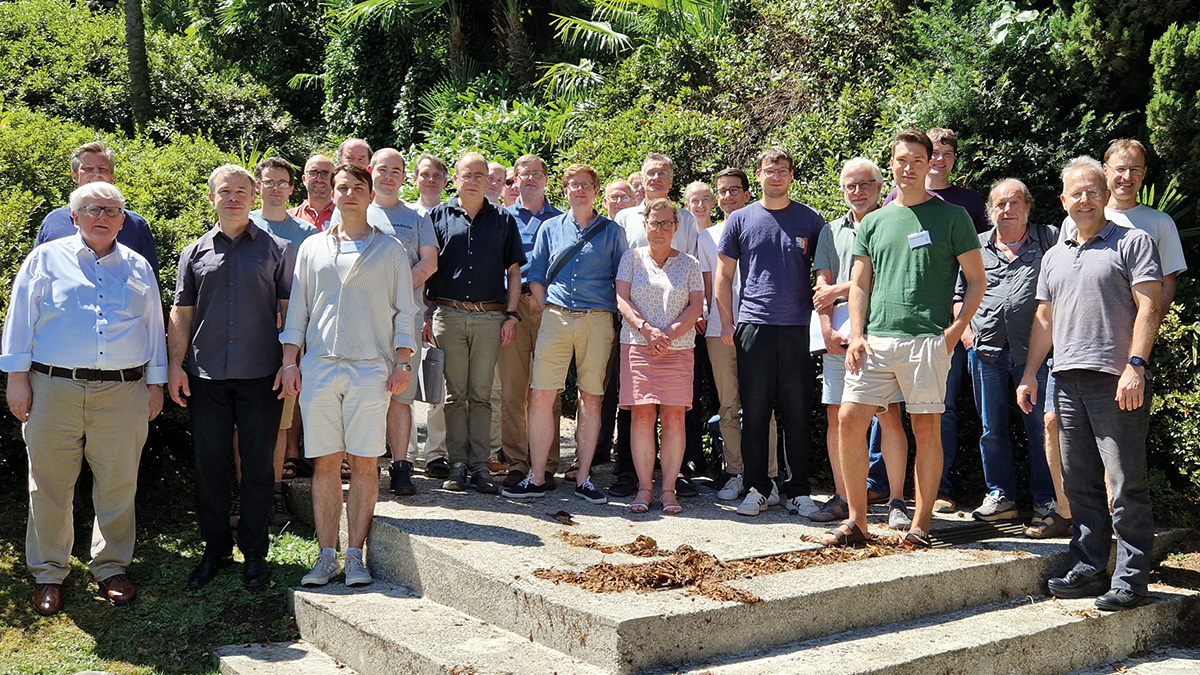
Measurements at high-energy colliders such as the LHC, the Electron–Ion Collider (EIC) and the FCC will be performed at the highest luminosities. The analysis of the high-precision data taken there will require a significant increase in the accuracy of theoretical predictions. To achieve this, new mathematical and algorithmic technologies are needed. Developments in precision Standard Model calculations have been rapid since experts last met for Loopsummit-1 at Cadenabbia on the banks of Lake Como in 2021 (CERN Courier November/December 2021 p24). Loopsummit-2, held in the same location from 20 to 25 July this year, summarised this formidable body of work.
As higher experimental precision relies on new technologies, new theory results require better algorithms, both from the mathematical and computer-algebraic side, and new techniques in quantum field theory. The central software package for perturbative calculations, FORM, now has a new major release, FORM 5. Progress has also been achieved in integration-by-parts reduction, which is of central importance for reducing to a much smaller set of master integrals. New developments were also reported in analytic and numerical Feynman-diagram integration using Mellin–Barnes techniques, new compact function classes such as Feynman–Fox integrals, and modern summation technologies and methods to establish and solve gigantic recursions and differential equations of degree 4000 and order 100. The latest results on elliptic integrals and progress on the correct treatment of the γ5-problem in real dimensions were also presented. These technologies allow the calculation of processes up to five loops and in the presence of more scales at two- and three-loop order. New results for single-scale quantities like quark condensates and the ρ-parameter were also reported.
In the loop
Measurements at future colliders will depend on the precise knowledge of parton distribution functions, the strong coupling constant αs(MZ) and the heavy-quark masses. Experience suggests that going from one loop order to the next in the massless and massive cases takes 15 years or more, as new technologies must be developed. By now, most of the space-like four-loop splitting functions governing scaling violations are known with a good precision, as well as new results for the three-loop time-like splitting functions. The massive three-loop Wilson coefficients for deep-inelastic scattering are now complete, requiring far larger and different integral spaces compared with the massless case. Related to this are the Wilson coefficients of semi-inclusive deep-inelastic scattering at next-to-next-to leading order (NNLO), which will be important to tag individual flavours at the EIC. For the αs(MZ) measurement at low-scale processes, the correct treatment of renormalon contributions is necessary. Collisions at high energies also allow the detailed study of scattering processes in the forward region of QCD. Other long-term projects concern NNLO corrections for jet-production at e+e– and hadron colliders, and other related processes like Higgs-boson and top-quark production, in some cases with a large number of partons in the final state. This also includes the use of effective Lagrangians.
Many more steps lie ahead if we are to match the precision of measurements at high-luminosity colliders
The complete calculation of difficult processes at NNLO and beyond always drives the development of term-reduction algorithms and analytic or numerical integration technologies. Many more steps lie ahead in the coming years if we are to match the precision of measurements at high-luminosity colliders. Some of these will doubtless be reported at Loopsummit-3 in summer 2027.